Your vehicle at a glance
Exterior overview
Front view
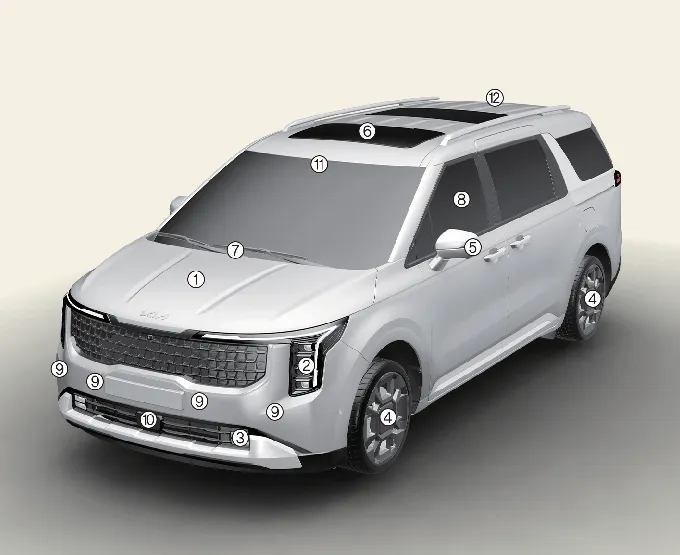
* Note: The actual configuration and appearance of your specific Kia Carnival may vary from this general illustration.
Hood: Access and maintenance details.
Head lamp: Lighting system and adjustment information.
Front fog lamp: Weather-adaptive illumination.
Wheel and tire: Specifications, pressure monitoring, and maintenance.
Outside rearview mirror: Adjustment and folding mechanisms.
Sunroof: Operation and safety features.
Front windshield wiper blades: Replacement and service modes.
Windows: Power operation and child safety locks.
Front ultrasonic sensor: Parking assistance system.
Front radar: Adaptive cruise control and collision avoidance components.
Front view camera: Advanced driver assistance systems (ADAS).
Roof rack: Cargo capacity and installation limits.
Rear view
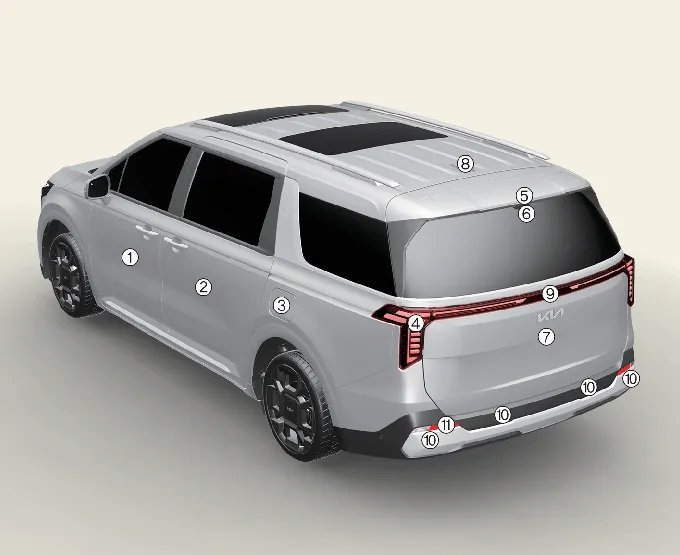
* Note: The actual configuration and appearance of your specific Kia Carnival may vary from this general illustration.
Doors: Locking and access controls.
Sliding doors: Power operation and obstruction safety.
Fuel filler door: Release and refueling procedure.
Rear combination lamp: Lighting functions and bulb replacement.
High mounted stop lamp: Safety brake light illumination.
Rear wiper: Operation and cleaning efficiency.
Wide-rear view camera: Parking assist and visibility enhancement.
Antenna: Signal reception for audio and navigation.
Liftgate: Power tailgate operation and adjustment.
Rear ultrasonic sensor: Proximity detection for reversing.
Reversing lamp/Turn signal lamp: Signaling and safety lighting.
Interior overview

* Please note that the actual configuration and interior design of your specific Kia Carnival may vary from this illustration based on the trim level and regional specifications.
Inside door handle: For convenient entry and exit.
Power window switch: Full control over vehicle glass movement.
Central door lock switch: Secures all vehicle entry points.
Central door unlock switch: Quick access to cabin interior.
Outside rearview mirror control switch: Precision adjustment for side visibility.
Outside rearview mirror folding switch: Retracts mirrors for tight spaces.
Power window/sunroof lock button: Enhanced child safety control.
Instrument panel illumination control switch: Adjusts dashboard brightness.
ESC OFF button: Electronic Stability Control management.
Steering wheel: Central command for vehicle direction.
Steering wheel tilt/telescopic lever: Ergonomic adjustment for optimal driving posture.
Instrument fuse panel: Access to electrical protection circuits.
Shift lever: Gear selection interface for the Kia Carnival powertrain.
Hood release lever: Manual access to the engine compartment.
Seat: Lumbar and position adjustment settings.
Instrument panel overview
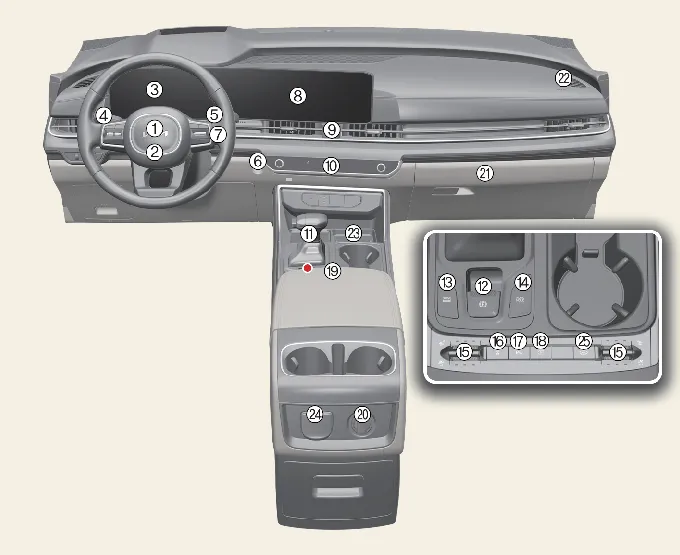
* Please note that the actual layout of the instrument panel in your Kia Carnival may vary slightly depending on your specific model configuration.
Driver's front air bag: Primary SRS safety system.
Horn: Auditory warning system.
Instrument cluster: Displays essential speed, fuel, and diagnostic information.
Light control/turn signals lever: External illumination and signaling.
Wiper and washer control lever: Visibility management systems.
ENGINE START/STOP button: Keyless ignition system.
Driving Assist button: Activates advanced driver safety features.
Infotainment system: Multimedia, navigation, and vehicle settings.
Hazard warning flasher switch: Emergency signaling.
Climate control system: Advanced cabin temperature regulation.
Shift lever: Electronic gear shift control.
EPB switch: Electric Parking Brake activation.
Drive mode integrated control system: Tailors vehicle performance characteristics.
AUTO HOLD button: Maintains brake pressure at full stops.
Front seat warmer/air ventilation seat switch: Integrated climate comfort settings.
Steering wheel heater button: Thermal comfort for winter conditions.
Parking Safety button: Activation for ultrasonic and proximity sensors.
Parking/View button: Surround-view camera system initialization.
Center console storage box: Versatile cabin storage solution.
Power outlet: 12V supply for portable electronics.
Glove box: Dedicated storage for manual and documentation.
Passenger's front air bag: Supplemental restraint system.
Wireless charging system: Integrated Qi-compatible device charging.
AC Inverter: Power source for household-style electrical appliances.
Front glass heater button: De-icing and defrosting for enhanced visibility.
Engine compartment
Smartstream G3.5 GDi
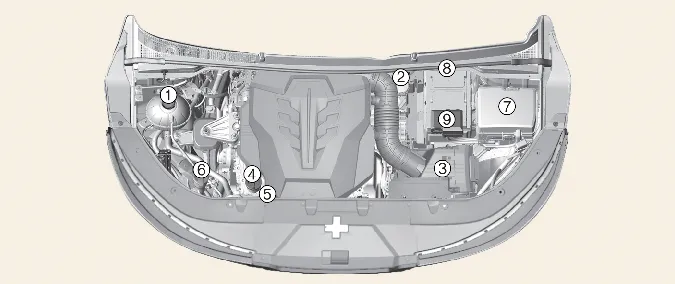
* Note: The actual arrangement of the engine compartment in your Kia Carnival may differ based on engine variants.
Engine coolant reservoir: Monitors vital engine thermal management.
Brake fluid reservoir: Ensures optimal hydraulic braking performance.
Air cleaner: Protects the intake system from particulates.
Engine oil filler cap: Accessible point for periodic lubrication top-ups.
Engine oil dipstick: Enables manual inspection of oil levels and quality.
Windshield washer fluid reservoir: Critical for maintaining clear forward vision.
Fuse box: Central electrical distribution for engine bay components.
Negative battery terminal: Primary ground connection point.
Positive battery terminal: Primary 12V electrical feed.
More Kia Carnival reference pages
Kia Carnival (KA4) 2022-2026 Owner's Manual: Tire Pressure Monitoring System (TPMS)
The Tire Pressure Monitoring System (TPMS) in your Kia Carnival is a sophisticated safety feature designed to continuously track the inflation level of each tire. By utilizing individual sensors mounted within each wheel, the system provides real-time pressure data directly to the LCD display on your instrument cluster, ensuring you are always aware of your vehicle's tire health.
Kia Carnival (KA4) 2022-2026 Owner's Manual: Automatic transmission operation
The Kia Carnival is equipped with a sophisticated 8-speed automatic transmission designed to balance fuel economy with responsive power. Gear ratios are selected automatically by the vehicle’s computer based on driving conditions, throttle input, and load. NOTICE If the vehicle's battery has been disconnected, the Transmission Control Module (TCM) may need to "re-learn" shift patterns.