Air bag collision sensors
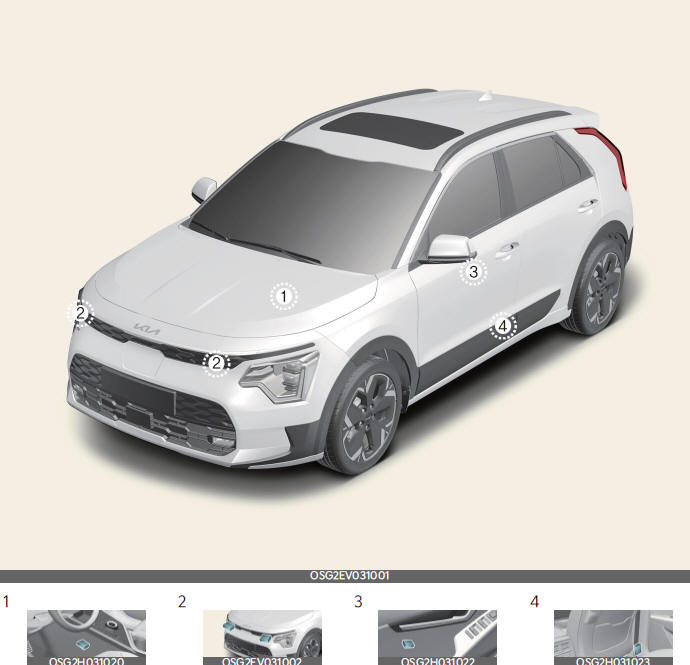
* The actual features in your vehicle may not necessarily be available due to the selected options or regions.
- Supplemental Restraint System (SRS) control module/rollover sensor
- Front impact sensor
- Side pressure sensors (front door)
- Side impact sensor (B-pillar)
WARNING
- Do not hit or allow any objects to impact the locations where air bag or sensors are installed.
This may cause unexpected air bag deployment, which could result in serious personal injury or death.
- If the installation location or angle of the sensors is altered in any way, the air bags may deploy when they should not or they may not deploy when they should, causing severe injury or death.
Therefore, do not try to perform maintenance on or around the air bag sensors.
Have the system serviced by a professional workshop. Kia recommends visiting an authorized Kia dealer/service partner.
- Problems may arise if the sensor installation angles are changed due to the deformation of the front bumper, body or B pillar where side collision sensors are installed. In this case, have the system serviced by a professional workshop. Kia recommends to visit an authorized Kia dealer/service partner.
- Your vehicle has been designed to absorb impact and deploy the air bag(s) in certain collisions.
Use only Kia Genuine Parts or those of an equivalent standard to install bumper guards or replace a bumper.
If not, it may adversely affect your vehicle's collision and air bag deployment performance.
- If equipped with rollover sensor If your vehicle is equipped with side and curtain air bag, press EV button to OFF position and wait for 3 minutes when the vehicle is being towed.
The side and curtain air bag may deploy when the EV button is in ON or OFF position within 3 minutes, and the rollover sensor detects the situation as a rollover.
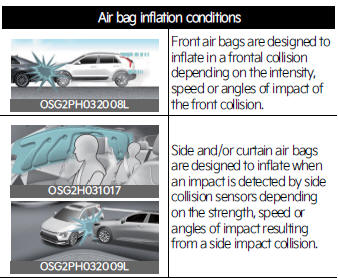
Air bag inflation conditions
INFORMATION
Side and curtain air bags (if equipped)
Also, the side and curtain air bags are designed to inflate when a rollover is detected by a rollover sensor.
Although the front air bags (driver's and front passenger's air bags) are designed to inflate only in frontal collisions, they also may inflate in other types of collisions if the front impact sensors detect a sufficient impact. Side air bags (side and/or curtain air bags) are designed to inflate only in side impact collisions, but they may inflate in other collisions if the side impact sensors detect a sufficient impact.
For instance, side airbag and curtain air bags may inflate if rollover sensors indicate the possibility of a rollover occurring (even if none actually occurs) or in other situations, including when the vehicle is tilted while being towed. Even if side and/or curtain air bags do not provide impact protection in a rollover, they will deploy to prevent ejection of occupants, especially those who are restrained with seat belts.
If the vehicle chassis is impacted by bumps or objects on unimproved roads or sidewalks, air bags may deploy. Drive carefully on unimproved roads or on surfaces not designed for vehicle traffic to prevent unintended air bag deployment.
NOTICE
If equipped with rollover sensor
Also, the side and curtain air bags are designed to inflate when a rollover is detected by a rollover sensor.