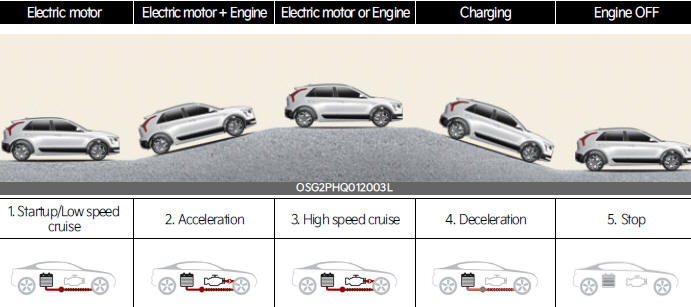
PHEV (Plug-in Hybrid Electric Vehicle) system / HEV (Hybrid Electric Vehicle) system
PHEV (Plug-in Hybrid Electric Vehicle) system
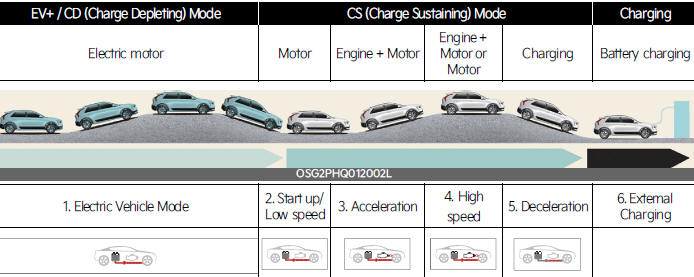
The Kia Plug-in Hybrid Electric Vehicle (PHEV) shares the characteristics of both a conventional hybrid electric vehicle and an all-electric vehicle.
When used as a conventional hybrid electric vehicle, the HEV computer selectively operates between the engine and the electric motor or even both at the same time.
When it is operating in the electric vehicle mode, the vehicle is driven only using the electric motor over a certain distance until the hybrid battery becomes low. The driving distance in EV mode depends on customer driving style and road conditions.
Aggressive driving maneuvers may at times temporarily enable the engine to operate.
The engine power could be limited during emission reduction control period at cold engine condition.
The hybrid battery can be fully charged by connecting a plug to an external electric power source.
An engine can be turned on due to factors such as heater and a frequent operation of the accelerator pedal by a driver in CD mode.
HEV (Hybrid Electric Vehicle) system
The Kia Hybrid Electric Vehicle (HEV) uses both the gasoline engine and the electric motor for power. The electric motor is run by a high-voltage HEV battery.
Depending on the driving conditions, the HEV computer selectively operates between the engine and the electric motor or even both at the same time.
Fuel efficiency increases when the vehicle is driven by the electric motor with the HEV battery.
The HEV battery charge must be maintained, so at times the engine will come on even at idle to act as a generator. Charging also occurs when decelerating or by regenerative braking.