Basic inspection
DETAILED FLOW
1.INTERVIEW FROM THE CUSTOMERClarify customer complaints before inspection. First of all, perform an interview utilizing BRC-34, "Diagnostic Work Sheet" and reproduce the symptom as well as fully understand it. Ask customer about his/her complaints carefully.Check symptoms by driving vehicle with customer, if necessary.
CAUTION:Customers are not professional. Never guess easily like “maybe the customer means that...,” or “ maybe the customer mentions this symptom”.
>> GO TO 2.
2.CHECK SYMPTOMReproduce the symptom that is indicated by the customer, based on the information from the customer obtained by interview. Also check that the symptom is not caused by fail-safe mode. Refer to BRC-19, "Failsafe".
CAUTION:When the symptom is caused by normal operation, fully inspect each portion and obtain the understanding of customer that the symptom is not caused by a malfunction.
>> GO TO 3.
3.PERFORM THE SELF-DIAGNOSIS With CONSULT-III.
Perform self-diagnosis for “ABS”.
Is DTC detected? YES >> Record or print self-diagnosis results and GO TO 4.
NO >> GO TO 6. 4.RECHECK THE SYMPTOM With CONSULT-III.
1. Erase self-diagnostic results for “ABS”.
2. Perform DTC confirmation procedures for the error-detected system.
NOTE:
If some DTCs are detected at the some time, determine the order for performing the diagnosis based on BRC-30, "DTC Inspection Priority Chart" [ABS actuator and electric unit (control unit)].
Is any DTC detected? YES >> GO TO 5.
NO >> Check harness and connectors based on the information obtained by interview. Refer to GI-42, "Intermittent Incident".
5.REPAIR OR REPLACE ERROR-DETECTED PART • Repair or replace error-detected parts. • Reconnect part or connector after repairing or replacing.• When DTC is detected, erase self-diagnostic result for “ABS”.
>> GO TO 7.
6.IDENTIFY ERROR-DETECTED SYSTEM BY SYMPTOM DIAGNOSISEstimate error-detected system based on symptom diagnosis and perform inspection.
Can the error-detected system be identified?
YES >> GO TO 7.
NO >> Check harness and connectors based on the information obtained by interview. Refer to GI-42, "Intermittent Incident".
7.FINAL CHECKWith CONSULT-III.
1. Check the reference value for “ABS”.
2. Recheck the symptom and check that the symptom is not reproduced on the same conditions.
Is the symptom reproduced? YES >> GO TO 3.
NO >> INSPECTION END
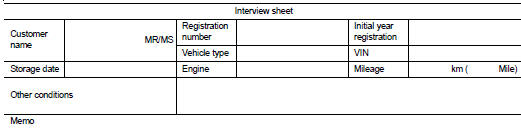
Diagnostic Work Sheet Description• In general, customers have their own criteria for a problem. Therefore, it is important to understand the symptom and status well enough by asking the customer about his/her concerns carefully. To systemize all the information for the diagnosis, prepare the interview sheet referring to the interview points.
• In some cases, multiple conditions that appear simultaneously may cause a DTC to be detected.
INTERVIEW SHEET SAMPLE