Power Supply, Ground & Circuit Elements

System description

In this manual: Power Supply, Ground & Circuit Elements
Foreword — 1General information — 45Engine Mechanical MR16DDT — 61Engine Mechanical HR16DE — 52Engine Mechanical K9K — 46Engine Lubrication System MR16DDT — 18Engine Lubrication System HR16DE — 14Engine Lubrication System K9K — 11Engine Cooling System MR16DDT — 28Engine Cooling System HR16DE — 29Engine Cooling System K9K — 24Engine Control System MR16DDT — 163Engine Control System HR16DE — 115Engine Control System K9K — 129Fuel System MR16DDT — 13Fuel system HR16DE — 11Fuel system K9K — 12Exhaust system MR16DDT — 7Exhaust system HR16DE — 10Exhaust system K9K — 7Starting system — 24Accelerator control system — 6Clutch — 25Driveline transfer: TY21B — 77Driveline rear propeller Shaft: 3Fφ16-ETJ75 — 12Driveline rear final drive: RTVS — 31Transaxle & transmission 5MT: RS5F92R — 31Transaxle & transmission 6MT: RS6F94R — 30Transaxle & transmission CVT: RE0F10B — 93Transaxle & transmissioN CVT: RE0F11A — 103Front Axle MR16DDT — 18Front Axle HR16DE — 17Front Axle K9K — 17Rear Axle 2WD — 6Rear Axle 4WD — 13Front Suspension — 21Rear Suspension 2WD — 13Rear Suspension 4WD — 17Road Wheels & Tires — 6Brake System LHD — 24Brake System RHD — 24Parking Brake System — 8Brake Control System without ESP — 44Brake Control System with ESP — 63Steering System — 14Steering Control System — 27Seat Belt — 8SRS Airbag — 24SRS Airbag Control System — 93Ventilation System — 11Heater & Air Conditioning System HR16DE — 28Heater & Air Conditioning System MR16DDT — 28Heater & Air Conditioning Control System Type 1 — 49Heater & Air Conditioning Control System Type 2 — 51Heater & Air Conditioning Control System Type 3 — 32Heater & Air Conditioning Control System Type 4 — 40Heater & Air Conditioning Control System Type 5 — 21Interior — 16Instrument Panel — 10Seat — 18Door & Lock Type 1 — 83Door & Lock type 2 — 80Door & Lock type 3 — 65Door & Lock type 4 — 60Security Control System with intelligent key system — 82Security Control System without intelligent key system — 41Glass & Window System — 15Power Window Control System — 28Body Repair — 13Exterior — 20Mirrors — 26Exterior Lighting System Halogen type — 51Interior Lighting System — 24Wiper & Washer — 45Defogger — 31Horn — 4Power Outlet — 4Body Control System With intelligent key system — 21Body Control System Without intelligent key system — 23LAN system can fundamental — 6LAN system can — 31LAN System can system (type 1) — 1LAN System can system (type 2) — 1LAN System can system (type 3) — 1LAN System can system (type 4) — 1LAN System can system (type 5) — 1LAN System can system (type 6) — 1LAN System can system (type 7) — 2LAN System can system (type 8) — 1LAN System can system (type 9) — 1LAN System can system (type 10) — 1LAN System can system (type 11) — 1Power Control System IPDM E/R (with I-key) — 14Power Control System IPDM E/R (without I-key) — 14Power Control System Power distribution system — 25Charging System — 22Power Supply, Ground & Circuit Elements — 20Meter, Warning Lamp & Indicator — 33Warning Chime System — 22Audio, Visual & Navigation System Audio without navigation — 30Audio, Visual & Navigation System Audio with navigation — 33Audio, Visual & Navigation System NISSAN dynamic control system — 22Cruise Control System — 1Drive Mode System — 10Maintenance — 14
~2min read
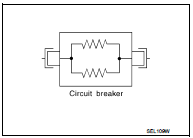
COMPONENT PARTS Circuit Breaker

The PTC thermistor generates heat in response to current flow. The temperature (and resistance) of the thermistor element varies with current flow. Excessive current flow will cause the element's temperature to rise. When the temperature reaches a specified level, the electrical resistance will rise sharply to control the circuit current.

Reduced current flow will cause the element to cool. Resistance falls accordingly and normal circuit current flow is allowed to resume.
Battery

Battery
HR*: Because of the frequent battery charge/discharge performed according to

HR*: Because of the frequent battery charge/discharge performed according to a driving condition and a battery condition, this model uses a charge/discharge capacity-enhanced battery. Therefore, it is recommended to use a genuine battery when replacement is needed.

Harness Connector

HARNESS CONNECTOR (TAB-LOCKING TYPE)

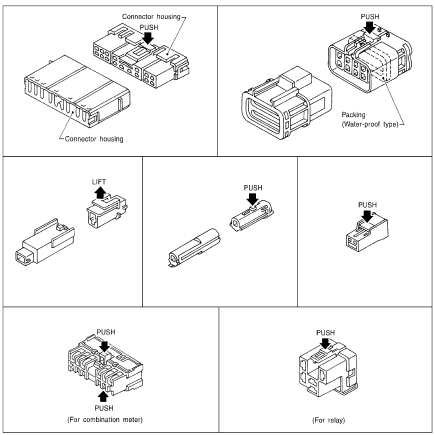
• The tab-locking type connectors help prevent accidental looseness or disconnection.

• The tab-locking type connectors are disconnected by pushing or lifting the locking tab(s). Refer to the figure below.

CAUTION:
Never pull the harness or wires when disconnecting the connector.

[Example]
HARNESS CONNECTOR (SLIDE-LOCKING TYPE)

HARNESS CONNECTOR (SLIDE-LOCKING TYPE)

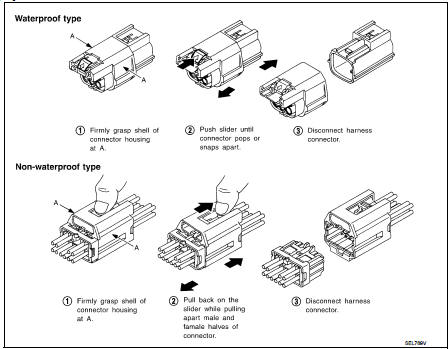
• A new style slide-locking type connector is used on certain systems and components, especially those related to OBD. • The slide-locking type connectors help prevent incomplete locking and accidental looseness or disconnection.

• The slide-locking type connectors are disconnected by pushing or pulling the slider. Refer to the figure below.

CAUTION:
• Never pull the harness or wires when disconnecting the connector.

• Be careful not to damage the connector support bracket when disconnecting the connector.

[Example]
HARNESS CONNECTOR (LEVER LOCKING TYPE)

HARNESS CONNECTOR (LEVER LOCKING TYPE)

• Lever locking type harness connectors are used on certain control units and control modules such as ECM, ABS actuator and electric unit (control unit), etc. • Lever locking type harness connectors are also used on super multiple junction (SMJ) connectors.

• Always confirm the lever is fully locked in place by moving the lever as far as it will go to ensure full connection.

CAUTION:
Always confirm the lever is fully released (loosened) before attempting to disconnect or connect these connectors to avoid damage to the connector housing or terminals.
1. Control unit with single lever

1. Control unit with single lever A. Fasten
B. Loosen
C. Lever

2. Control unit with dual levers A. Levers
B. Fasten
C. Loosen

3. SMJ connector
A. Lever
B. Fasten
C. Loosen

Standardized Relay

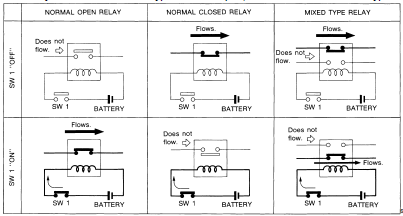
NORMAL OPEN, NORMAL CLOSED AND MIXED TYPE RELAYS

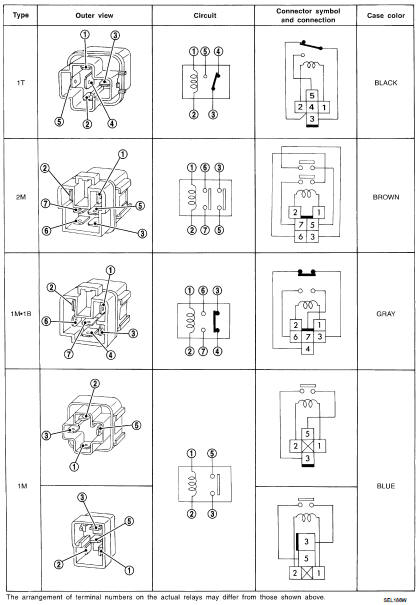
Relays can mainly be divided into three types: normal open, normal closed and mixed type relays.
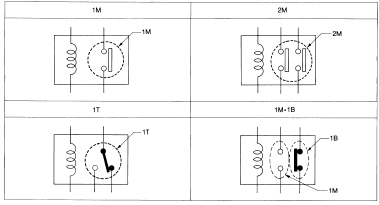
TYPE OF STANDARDIZED RELAYS

TYPE OF STANDARDIZED RELAYS

1M ···················· 1 Make 2M ···················· 2 Make

1T ···················· 1 Transfer 1M·1B ···················· 1 Make 1 Break

Wiring diagram