Blind Spot Warning (BSW)
WARNING
Failure to strictly adhere to the safety warnings and operational instructions for the proper use of the Blind Spot Warning (BSW) system could result in a collision, potentially causing serious injury or death.
- The BSW system is intended to supplement, not replace, standard, vigilant driving procedures and is not designed to mechanically prevent contact with other vehicles or stationary objects. When attempting to change lanes in your Nissan Leaf, you must always rely on your own vision by checking the side and rearview mirrors, and physically turning to look in the direction your vehicle will move to ensure the path is clear. Never rely solely on the BSW system to confirm it is safe to change lanes.
The Blind Spot Warning system is designed to provide an additional layer of awareness, helping to alert the driver to the presence of other vehicles positioned in adjacent lanes, which is particularly useful during lane-change maneuvers.
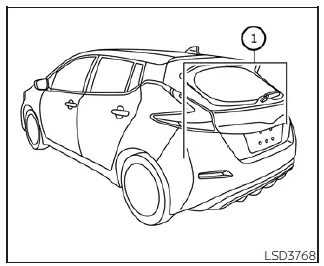
To function effectively, the BSW system utilizes advanced radar sensors (1) discreetly installed near the rear bumper assembly to continuously scan the surrounding traffic for vehicles occupying your vehicle's blind spot in an adjacent lane.

Detection zone
The high-sensitivity radar sensors are engineered to detect vehicles on either side of your Nissan Leaf within a specific detection envelope. As illustrated, this coverage zone initiates from the trailing edge of your vehicle’s outside rearview mirror and extends approximately 10 feet (3.0 meters) rearward from the rear bumper, while also monitoring approximately 10 feet (3.0 meters) outward to the side of the vehicle.