Illustrated Guide to Your Nissan Leaf Features
Instrument Panel
In this manual: Illustrated Guide to Your Nissan Leaf Features
26steps
~156min
4/5difficulty
Done 0 of 26
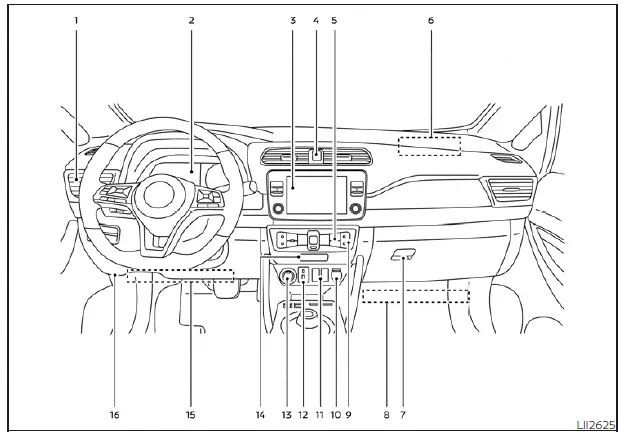
- Vents: Adjustable climate control outlets for personalized cabin airflow.
- Meters and gauges: Comprehensive digital driver information display providing real-time vehicle data.
- Center multi-function control panel*: Central hub for infotainment, connectivity, and navigation settings.
- Hazard warning flasher switch: Easily accessible switch for emergency lighting activation.
- Rear window and outside mirror defroster switch: Essential controls for maintaining visibility in cold or humid weather conditions (where equipped).
- Front passenger supplemental air bag: Standard safety restraint module for front-seat passenger protection.
- Glove box: Convenient storage compartment for documentation and personal items.
- Front passenger supplemental knee airbag: Added lower-body protection integrated into the Nissan Leaf dashboard.
- Heater and air conditioner control: Intuitive interface for managing the Nissan Leaf cabin climate and comfort.
- Power outlet: Auxiliary charging point for portable electronics.
- Front heated seat switches: Controls for adjustable seat warming (if so equipped).
- USB connection port*: Interface for mobile device integration and media playback.
- Push-button power switch: One-touch system to start or turn off the electric powertrain.
- Front passenger air bag status light: Visual indicator showing the operational state of the passenger restraint system.
- Driver supplemental knee airbag: Safety module designed to enhance lower-body protection for the driver.
- Hood release handle: Mechanical lever for accessing the motor compartment.
Meters and Gauges
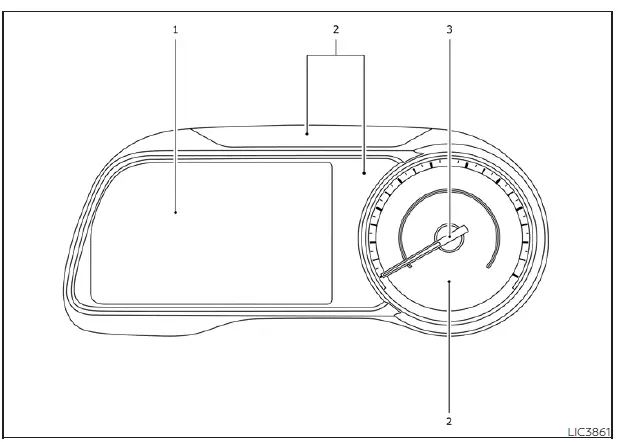
- Vehicle information display: The central digital cockpit feature for the Nissan Leaf, including:
- Clock and outside air temperature readings.
- Li-ion battery available charge gauge for monitoring energy levels.
- Estimated driving range based on current efficiency and battery state.
- Odometer and twin trip odometers for distance tracking.
- Timer indicators for scheduled charging.
- Power meter displaying real-time energy consumption and regenerative braking.
- ECO mode status indicator for optimized power usage.
- Warning and indicator lights: Critical alert system including turn signal/hazard indicators and the "READY" to drive notification.
- Speedometer: High-visibility digital display for precise speed monitoring.
Motor compartment
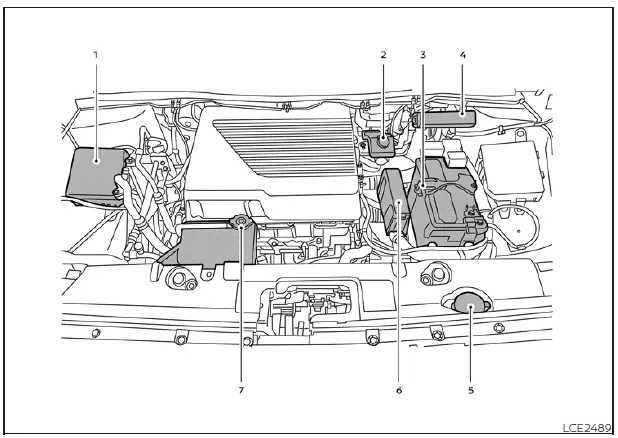
- Fuse/Fusible link holder: Protected central hub for the vehicle's electrical circuit distribution.
- Brake fluid reservoir: Accessible container for monitoring and maintaining hydraulic braking system fluid levels.
- 12-volt battery: Secondary power source supporting internal systems, lighting, and vehicle electronics.
- Fuse holder: Secondary electrical safety hub for internal systems.
- Windshield-washer fluid reservoir: Easy-fill location for maintaining clear visibility through the windshield.
- Fuse/Fusible link holder: Additional distribution point for high-amperage electrical protection.
- Coolant reservoir cap: Maintenance point for the specialized electric powertrain cooling system.
NOTE:
Your specific Nissan Leaf configuration may not be equipped with a motor cover, which is normal for certain model versions.
Was this page helpful?