Vehicle specifications
Tire information
In this manual: Vehicle specifications
19steps
~114min
4/5difficulty
Done 0 of 19
Typical tire symbols
Full-size tire

- Tire size
- DOT and Tire Identification Number (TIN)
- Uniform tire quality grading
For details, see "Uniform Tire Quality Grading" that follows. - Location of treadwear indicators
- Tire ply composition and materials
Plies are layers of rubber-coated parallel cords. Cords are the strands which form the plies in a tire. - Radial tires or bias-ply tires
A radial tire has "RADIAL" on the sidewall. A tire not marked "RADIAL" is a bias-ply tire. - TUBELESS or TUBE TYPE
A tubeless tire does not have a tube and air is directly put into the tire. A tube type tire has a tube inside the tire and the tube maintains the air pressure. - Load limit at maximum cold tire inflation pressure
- Maximum cold tire inflation pressure
This means the pressure to which a tire may be inflated. - Summer tires or all season tires
An all season tire has "M+S" on the sidewall. A tire not marked "M+S" is a summer tire.
Compact spare tire
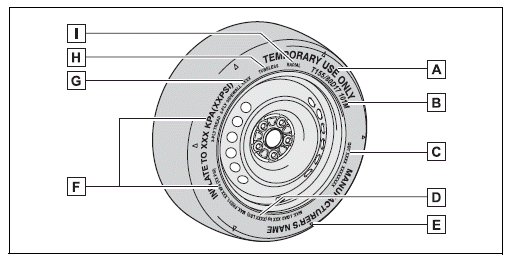
- "TEMPORARY USE ONLY"
A compact spare tire is identified by the phrase "TEMPORARY USE ONLY" molded on its sidewall. This tire is designed for temporary emergency use only. - Tire size
- DOT and Tire Identification Number (TIN)
- Load limit at maximum cold tire inflation pressure
- Location of treadwear indicators
- Maximum cold tire inflation pressure
This means the pressure to which a tire may be inflated. - Tire ply composition and materials
Plies are layers of rubber-coated parallel cords. Cords are the strands which form the plies in a tire. - TUBELESS or TUBE TYPEV A tubeless tire does not have a tube and air is directly put into the tire. A tube type tire has a tube inside the tire and the tube maintains the air pressure.
- Radial tires or bias-ply tires
A radial tire has "RADIAL" on the sidewall. A tire not marked "RADIAL" is a bias-ply tire.
Was this page helpful?