Inspection
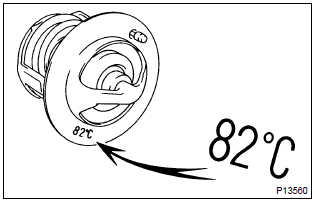
: the thermostat is numbered with the valve opening temperature.
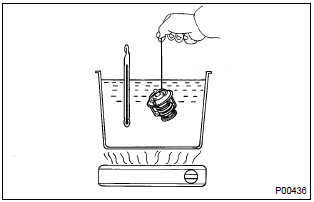
- Immerse the thermostat in water and gradually heat the water.
- check the valve opening temperature.
Valve opening temperature: 80 to 84 c (176 to 183 f)
: if the valve opening temperature is not as specified, replace the thermostat.
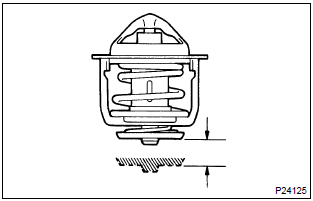
- Check the valve lift.
Valve lift: 10 mm (0.39 In.) Or more at 95 c (203 f)
: if the valve lift is not as specified, replace the thermostat.
- check that the valve is fully closed when the thermostat is at low temperatures (below 77 c (171 f)).
Hint: if not closed, replace the thermostat.
2. Radiator cap sub–assy Notice:
- if the radiator cap has contaminations, always rinse it with water.
- Before using a radiator cap tester, wet the relief valve and pressure valve with engine coolant or water.
- When performing step (a) and (b) below, keep the tester at an angle of over 30 above the horizontal.
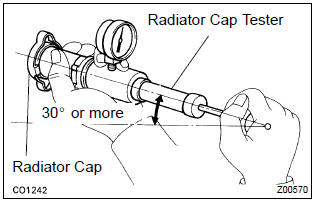
- Using a radiator cap tester, slowly pump the tester and check that air is coming from the vacuum valve.
Pump speed: 1 push / 3 seconds or more
: push the pump at a constant speed.
If air is not coming from the vacuum valve, replace the radiator cap.- pump the tester and measure the relief valve opening pressure.
Pump speed: 1 push within 1 second
Notice: the above pump speed is for the first pump only (in order to close the vacuum valve). After the first pump, the pump speed can be reduced. Standard opening pressure: 74 to 103 kpa (0.75 To 1.05 Kgf/cm2, 10.7 To 14.9 Psi) minimum opening pressure: 59 kpa (0.6 Kgf/cm2, 8.5 Psi)
Hint: use the tester’s maximum reading as the opening pressure.
If the opening pressure is less than minimum, replace the radiator cap.
Test yourself
A quick Toyota Corolla quiz: every answer comes with an explanation and a link to the manual page.