If you have a flat tire (vehicles with run-flat tires)
Your vehicle is not equipped with a spare tire, but instead you can continue driving the vehicle with run-flat tires even if any tire goes flat.
In this case, slow down and drive with extra caution.
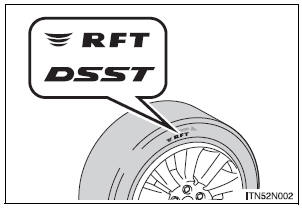
Run-flat tires (A “RFT” or “DSST” mark is molded on the sidewall)
Take your vehicle to the nearest Toyota dealer or authorized tire dealer as soon as possible if any tire goes flat.
The vehicle can be driven for a maximum of 100 miles (160 km) at a speed below 80 km/h after the tire pressure warning light comes on.
In some condition (such as at high temperatures)
You cannot continue driving for up to 100 miles (160 km).
For the detailed information on run-flat tires
See the tire warranty booklet.
NOTICEWhen replacing the tires
When removing or fitting the wheels, tires or the tire pressure warning valve and transmitter, contact your Toyota dealer as the tire pressure warning valve and transmitter may be damaged if not handled correctly.
When driving over bumps
If a vehicle has a flat tire, the vehicle height will be lower than usual.
Ensure that nothing strikes the bottom of the vehicle.
To avoid damaging the tire pressure warning valves and transmitters
When a tire is repaired with liquid sealants, the tire pressure warning valve and transmitter may not operate properly. If a liquid sealant is used, contact your Toyota dealer or other qualified service shop as soon as possible. Make sure to replace the tire pressure warning valve and transmitter when replacing the tire.
Test yourself
A quick Toyota Sienna quiz: every answer comes with an explanation and a link to the manual page.