Before the journey
Adjusting the head restraints
In this manual: Before the journey
~2min read
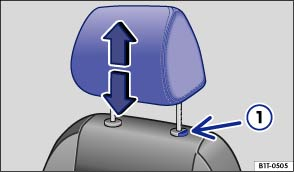
Fig. 42 Adjusting front head restraint

Fig. 43 Adjusting rear L-shaped head restraint.
 First read and observe the introductory information and safety warnings
Every seat is fitted with a head restraint.
Adjusting the height
- Push the head restraint up in the direction of the arrow or push it down with the button pressed or .
- The head restraint must click securely into position. In the second row of seats there are three possible positions; in the third row of seats there are two possible positions.
Correct head restraint setting
Adjust the head restraint so that its upper edge is at the same height as the top of the head, but not lower than eye level. Position the back of your head as close to the head restraint as possible.
Head restraint setting for small people
Push the head restraint all the way down, even if the head is then located underneath the top edge of the head restraint. There may be a small gap between the head restraint and backrest in the lowest position.
Head restraint setting for large people
Push the head restraint up as far as it will go.
 Driving without head restraints or with incorrectly adjusted head restraints increases the risk of severe or fatal injuries in the event of an accident or sudden driving or braking manoeuvre.
- If a seat is occupied, the head restraint for that seat must be fitted and adjusted correctly.
- Each vehicle occupant must adjust the head restraint to suit their body size in order to reduce the risk of neck injuries in an accident. The upper edge of the head restraint must, as far as possible, be level with the top of the head, but no lower than eye level. Position the back of your head in the middle and as close to the head restraint as possible.
- Never adjust the head restraint when the vehicle is in motion.
Test yourself
A quick Volkswagen Touran quiz: every answer comes with an explanation and a link to the manual page.
Was this page helpful?