Tire pressure monitoring system
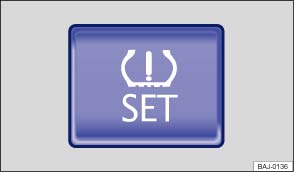 Fig. 125
In the center console: button for
the tire pressure monitoring system.
 Read and observe the introductory information
and safety warnings first⇒
 Introduction
to the topic
The tire pressure monitoring system uses the ABS wheel speed sensors to compare, among other things, the rotational speed and thus the rolling circumference of the individual wheels. A change in rolling circumference at one or more wheels is indicated by the tire pressure monitoring system in the instrument cluster.
Changes in rolling circumferenceThe rolling circumference of the tire may change:
- When the tire pressure has been changed manually.
- When the tire pressure is too low.
- When the tire has structural damage.
- When the vehicle is loaded unevenly from one side.
- When the wheels on one axle are under greater load, e.g. with a high payload.
- When snow chains are fitted.
- When a temporary spare wheel is fitted.
- When one wheel per axle has been replaced.
The tire pressure monitoring system may display a warning with a delay or not at all under certain
conditions, e.g. during sporty driving, on winter or unpaved roads, or when driving with snow chains.
After changing the tire pressures or after changing one or more wheels, the tire pressure monitoring system must be re-learned. This also applies after rotating the wheels, e.g. from front to rear.
To re-learn the system, the stored values must first be reset.
- Switch the ignition on.
- Press and hold button ⇒ Fig. 125 until a confirmation tone sounds.
After the stored values have been reset, the system learns the tire inflation pressures filled by the driver and the mounted tires automatically during normal driving. After a longer drive at varying speeds, the learned values are adopted and monitored.
If the wheels are subject to heavy loads, e.g. high payload, increase the tire inflation pressure to the recommended full-load tire inflation pressure before learning ⇒ Important information on wheels and tires .

 Warning
Improper use of the adjustment button may cause the tire pressure monitoring system to issue false warnings or fail to issue a warning despite dangerously low tire pressure. Make sure the tire pressure of all wheels is correct before pressing the adjustment button.

The tire pressure monitoring system does not function if the ESC or ABS has a malfunction ⇒ Braking, stopping and parking .
After a warning about low tire pressure, the vehicle must stand for about one minute and must not be moved. Alternatively, the ignition can be switched off and on again. Only then can the tire pressure monitoring system be re-learned using the button ⇒ Fig. 125 .
When driving with a spare wheel or temporary spare wheel, a false indication may occur because the rolling circumference of the spare or temporary spare wheel may differ from that of the other wheels.
When using snow chains, a false indication may occur because the snow chains increase the rolling circumference.