Warning and indicator lights and fuel level indicator
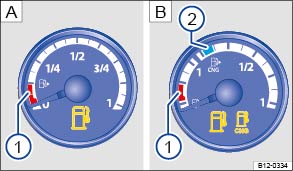 Fig. 114
In the instrument cluster display:
Fuel level indicator for gasoline. Fuel level indicator for gasoline and natural gas.
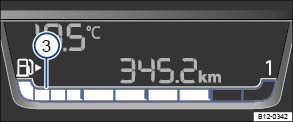 Fig. 115
In the instrument cluster display:
Fuel level indicator for gasoline.
 Read and observe the introductory information
and safety warnings first⇒
 Introduction
to the topic
The fuel level indicator may differ depending on vehicle equipment ⇒ Fig. 114 or ⇒ Fig. 115.
Fuel level indicator| lights upa) | Pointer position ⇒ Fig. 114 | Possible cause ⇒ | Remedy |
|---|---|---|---|
 | red marking ① | Fuel tank almost empty. Reserve quantity is being used ⇒ Fill capacities. |
Refuel with gasoline at the next opportunity ⇒ . |
 | blue marking ② | Natural gas tank almost empty. Reserve quantity is being used. |
Refuel with natural gas at the next opportunity ⇒ . |
| flashes for approx. 10 secondsa) | Bar display ⇒ Fig. 115 | Possible cause ⇒ | Remedy |
|---|---|---|---|
 | Reserve marking flashes for approx. 10 seconds ③ | Fuel tank almost empty. Reserve quantity is being used ⇒ Fill capacities. |
Refuel at the next opportunity ⇒ . |
When the ignition is switched on, some warning and indicator lamps light up briefly to check their function. They go out after a few seconds.
For vehicles with a natural gas engineWhile driving, the fuel level gauge needle is in the range of the fuel currently in use. Each time the ignition is switched on, the needle first moves into the petrol range for a few seconds to show the current petrol level. It then moves into the natural gas (CNG) range. After the engine starts, the needle may move to the range of the current operating mode.
If the vehicle was parked for an extended period directly after refuelling, the natural gas level display may not show exactly the same level after restarting as it did directly after refuelling. This is not a leak in the system. It is a technically caused pressure drop in the CNG tanks directly after refuelling.

 Warning
Driving with too little fuel can cause the vehicle to stall in traffic, and lead to accidents and serious injuries.
- A low fuel level can cause irregular fuel supply to the engine, especially when driving up or down slopes.
- The steering, all driver assistance systems and brake assist systems do not work if the engine stutters or stalls due to lack of fuel or irregular fuel supply.
- Always refuel when the fuel tank is only about 1/4 full to avoid running out of fuel.

 Note
- Always observe illuminated warning lamps and the corresponding descriptions and notes to avoid damage to the vehicle.
- Never run the fuel tank completely empty. Irregular fuel supply can cause misfiring, and unburned fuel can enter the exhaust system. This can damage the catalytic converter!
Note Depending on driving conditions, fill level of the gas tank, and ambient and engine temperature, a brief automatic switch to gasoline operation is possible if the coolant temperature has not yet reached the required level for gas operation after starting. Once all conditions are met again, the system switches back to gas operation automatically.

The small arrow next to the fuel pump symbol in the instrument display ⇒ Fig. 114 shows which side of the vehicle the fuel filler flap is on.
a) Applies only to vehicles with a fuel level display in the instrument cluster display ⇒ Fig. 114 or ⇒ Fig. 115 .