Chassis
Acceptable Tread Depth Variance
In this manual: Chassis
~2min read
Model with Longitudinally Installed Engine
Tread variance for models with a longitudinally installed engine, such as A4, A5, A6, A7, A8, Q5, Q7, ...
In this case, the variance between the front and rear axle may not be more than 2 mm
 Note
- For all four wheels use only tires of the same construction type, size, and tread.
- Excepted are vehicles that were shipped by Audi AG with different sized tires on the front and rear axle.
- Always use tires with the deepest tread depth on the front axle.
- Changing one individual tire is generally possible. Audi recommends at the very least however that the tires are exchanged on both sides of the axle.
- With sport differential on the rear axle, Audi recommends always replacing the tires on both sides of the rear axle.
Note
The technical background of the limitations are thermal pressure for the transmission oil due to a large difference in the rolling circumference of the tires.

Models with Crossways Installed Engine
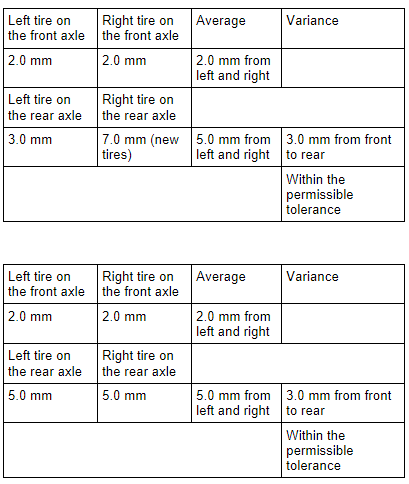
Tread depth variance for models with laterally installed engine, such as A3, TT, Q3, A1, ...
In this case, the variance between the front and rear axle may not be more than three mm
Note
- For all four wheels use only tires of the same construction type, size, and tread.
- Excepted are vehicles that were shipped by Audi AG with different sized tires on the front and rear axle.
- Always use tires with the deepest tread depth on the front axle.
- Changing one individual tire is generally possible. Audi recommends at the very least however that the tires are exchanged on both sides of the axle.
- With sport differential on the rear axle, Audi recommends always replacing the tires on both sides of the rear axle.
Note
The technical background of the limitations are thermal pressure for the transmission oil due to a large difference in the rolling circumference of the tires.
Was this page helpful?