Emergency Towing
If emergency towing is required, it is recommended to use an authorized HYUNDAI dealer or a commercial roadside assistance service.
If towing service is not available in an emergency, the vehicle can be towed for a short time with a rope or chain attached to the emergency towing hook located under the front (or rear) of the vehicle. Be very careful when towing the vehicle. The driver must remain in the vehicle to steer and operate the brake pedal.
This towing method is permitted only on paved roads, for short distances and at low speed. The wheels, axles, transmission, steering, and brake system must be in good condition.
• Do not use the towing hooks to pull the vehicle out of mud, sand, or other conditions from which it cannot drive out under its own power.
• Avoid towing a heavier vehicle with a lighter vehicle.
• Drivers of both vehicles should communicate frequently with each other.
Securely attach the rope or chain to the towing hook provided.
• Before emergency towing, make sure the hook is not broken or damaged.
• Securely attach the rope or chain to the hook.
• Do not jerk the hook. Apply force smoothly and evenly.
• To avoid damaging the hook, do not pull it sideways or vertically. Always pull straight ahead.
WARNING
Be very careful when towing the vehicle.
• Avoid sudden acceleration and other maneuvers that place extra load on the emergency towing hook, rope, or chain. The hook, tow rope, or chain may break and cause serious injury or damage.
• If the disabled vehicle cannot move, do not force the towing to continue. Contact an authorized HYUNDAI dealer or a commercial towing service for assistance.
• Tow the vehicle as straight as possible.
• Do not stand near the vehicle during towing.
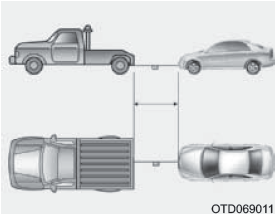
• The length of the tow rope must not exceed 5 m (16 ft). For visibility, attach a white or red cloth (approximately 30 cm (12 in) wide) to the middle of the rope.
• Drive carefully so that the tow rope does not slacken during towing.
Precautions for Towing a Disabled Vehicle
• Turn the ignition key to the ACC (Accessory) position so the steering wheel does not lock.
• Move the shift lever to the "N" (Neutral) position.
• Release the parking brake.
• Apply more force than usual to the brake pedal, as the brake booster will not operate.
• More effort will also be required to turn the steering wheel, as the power steering will not operate.
• If you are driving down a long slope, brake efficiency will decrease due to brake overheating. Stop more often and allow the brakes to cool.
CAUTION
- Automatic transaxle
• The vehicle may be towed with all four wheels on the ground in the forward direction only. Make sure the ignition key is in the ACC (Accessory) position and the steering wheel is unlocked. The driver must be in the towed vehicle to steer and operate the brake pedal.
• To prevent serious damage to the automatic transaxle, the towing speed must not exceed 15 km/h.
• Before towing, check the ATF level. If it is below the "HOT" range on the dipstick, add fluid. If you cannot add fluid, a flatbed tow truck must be used.
Platform hook (for flatbed towing, if equipped)
WARNING
Do not use the hooks under the front (or rear) of the vehicle for towing. These hooks are for platform (flatbed) loading ONLY. If tie-downs are used to secure the vehicle during towing, the tie-downs or the front (rear) bumper will be damaged, which may cause serious damage.
Test yourself
A quick Hyundai Solaris quiz: every answer comes with an explanation and a link to the manual page.