Recommended Lubricants and Capacities
To ensure proper performance and durability of the engine and transmission, use only lubricants of appropriate quality. Correct lubricants also contribute to engine efficiency, resulting in improved fuel economy.
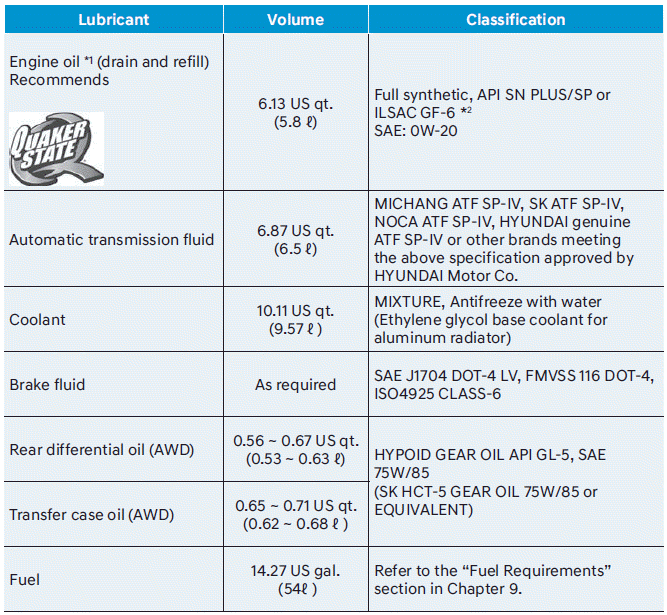
These lubricants and fluids are recommended for use in your vehicle.
NOTICE
Do not use low-quality fuel and lubricants that do not meet HYUNDAI specifications. Always use high-quality fuel and lubricants that meet the specifications listed in the recommendations table.
Recommended SAE Viscosity Number
NOTICE
Always clean the area around the filler plug, drain plug, or dipstick before checking or draining any lubricant. This is especially important in dusty or sandy areas and when the vehicle is driven on unpaved roads. Cleaning the area around the plug and dipstick will prevent dirt and sand from entering the engine and other components, which could be damaged.
The viscosity (thickness) of engine oil affects fuel economy and cold weather operation (engine starting and oil flow). Lower viscosity engine oils may provide better fuel economy and cold weather performance; however, higher viscosity engine oils are necessary for adequate lubrication in hot weather. Using oil of any viscosity other than the recommended one may cause engine damage.
When selecting oil, consider the temperature range in which your vehicle will operate until the next oil change. Refer to the chart to select the recommended oil viscosity.

Test yourself
A quick Hyundai Tucson LM quiz: every answer comes with an explanation and a link to the manual page.