Clutch Pedal Inspection [C66 M R]
For the clutch pedal inspection, note the followings and measure each inspection location.
Measure the center of the upper surface of the pedal pad for each inspection.
If the distance from the pedal pad to the floor covering is measured, measure the shortest distance from the center of the upper surface of the pedal pad to the floor covering.
1. Verify that there is no malfunction in the clutch fluid level..
2. Verify that there is no clutch fluid leakage..
Pedal Height Inspection1. Perform “Pedal Inspection Preparation”..
2. Measure the pedal height with the clutch pedal released as shown in the figure.
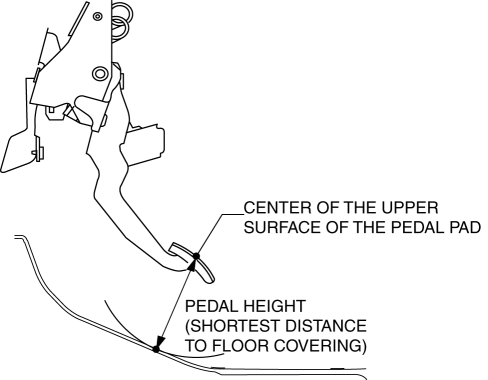
- Pedal height (reference value)
142.8 mm {5.622 in}
If it is not the specification, replace the clutch pedal..
1. Perform “Pedal Inspection Preparation”..
2. Depress the clutch pedal by hand until clutch resistance is felt, and measure the pedal free play as shown in the figure.
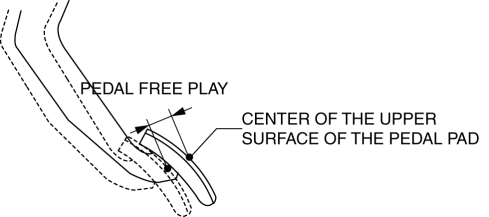
- Pedal free play (reference value)
15 mm {0.59 in} or less
If it exceeds the specification, replace the clutch pedal..
1. Perform “Pedal Inspection Preparation”..
2. Depress the clutch pedal from the released condition to the full depression position, and measure the pedal full stroke as shown in the figure.
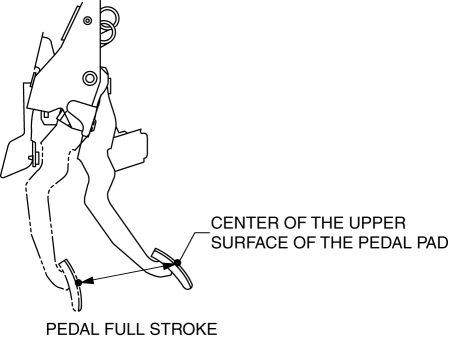
- Pedal full stroke (reference value)
140 mm {5.51 in}
If it is not the specification, replace the clutch pedal..
When performing the following procedure, make sure that the area around the vehicle is free of people or objects as the vehicle might move suddenly.
There are two methods for the clutch disengagement point inspection as follows: Perform any of the following inspection procedures for the clutch disengagement point inspection.
Procedure A: Procedure for measuring the distance from the clutch disengagement point to the floor.
Procedure B: Procedure for measuring the distance from the clutch disengagement point to the maximum clutch pedal depression position.
1. Perform “Pedal Inspection Preparation”..
2. Verify that the pedal height is normal..
3. Verify that the pedal free play is normal..
4. Verify that the pedal full stroke is normal..
5. Apply the parking brake and fix the front and rear of the wheels with the wheel chocks.
6. Start the engine.
7. With the clutch pedal depressed, move the shift lever to the position just before engaging the reverse gear. (Do not shift completely to reverse position)
8. Gradually release the clutch pedal and then hold it at the point where the sound of gear-grinding begins (clutch disengagement point).
9. Measure distance A as shown in the figure when the clutch pedal is at the clutch disengagement point.
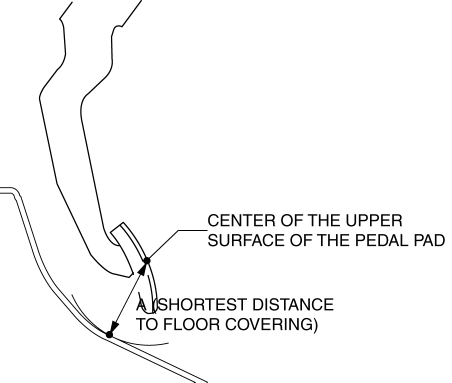
- Distance A (reference value)
52.3 mm {2.06 in} or more
If it is less than the specification, bleed the air from the clutch system..
1. Perform “Pedal Inspection Preparation”..
2. Verify that the pedal height is normal..
3. Verify that the pedal free play is normal..
4. Verify that the pedal full stroke is normal..
5. Apply the parking brake and fix the front and rear of the wheels with the wheel chocks.
6. Start the engine.
7. With the clutch pedal depressed, move the shift lever to the position just before engaging the reverse gear. (Do not shift completely to reverse position)
8. Gradually release the clutch pedal and then hold it at the point where the sound of gear-grinding begins (clutch disengagement point).
9. Depress the clutch pedal from the clutch disengagement point to the full depression position, and measure distance B as shown in the figure.
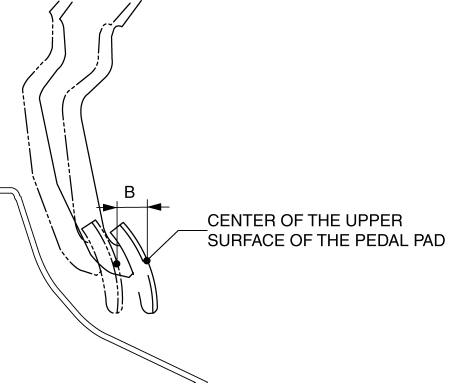
- Distance B (reference value)
12.5 mm {0.492 in} or more
If it is less than the specification, bleed the air from the clutch system..
Test yourself
A quick Mazda 3 quiz: every answer comes with an explanation and a link to the manual page.