Parking. Important safety information. Switching off the engine. Parking brake
The parking instructions for the Mercedes E-Class (4th generation, W212, 2009–2016) provide comprehensive recommendations for securing the vehicle safely. This section explains switching off the engine, using the parking brake, and measures to prevent the vehicle from rolling away or damaging the mechanical components.
Important Safety Notes
WARNINGIf flammable materials, e.g. leaves, grass or twigs, come into contact with hot parts of the exhaust system or the exhaust flow, these materials can ignite. Risk of fire!
Park the vehicle so that no flammable materials can come into contact with hot vehicle parts. In particular, do not park on dry grass or on harvested grain fields.WARNING
If you switch off the ignition while driving, safety-relevant functions are restricted or unavailable. This can affect, for example, the power steering and the brake booster. You will then need considerable force to steer and brake. There is a risk of an accident!Do not switch off the ignition while driving.
WARNING
If children are left unattended in the vehicle, they can set the vehicle in motion, for example by- releasing the parking brake
- shifting the automatic transmission out of the P (Park) position or shifting the manual transmission into neutral
- starting the engine.
Always take the key with you when leaving the vehicle and lock the vehicle. Never leave children unattended in the vehicle.
NOTE

Always secure the vehicle correctly against rolling away. Otherwise the vehicle or the drivetrain may be damaged.
To ensure that the vehicle is correctly secured against unintentional rolling away,
- the parking brake must be applied
- on vehicles with manual transmission, 1st gear or reverse gear must be engaged
- on vehicles with automatic transmission, the transmission must be in position P and the key must be removed
- on slopes or grades, the front wheels must be turned toward the curb.
Stopping the Engine
Important Safety Notes
WARNINGWhen the engine is switched off, the automatic transmission shifts to neutral position N. The vehicle can roll away. Risk of accident!
Always shift to park position P after switching off the engine. Secure the parked vehicle against rolling away with the parking brake.Vehicles with Manual Transmission
 Engage 1st gear or reverse gear R.Turn the key in the ignition lock to position 0 and remove it.
Firmly press the parking brake pedal.
Vehicles with Automatic Transmission
Firmly press the parking brake pedal.All vehicles (except AMG vehicles): Shift the transmission to position P.
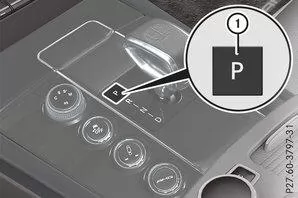
AMG vehicles: When the vehicle is stationary, press the button press.
With key: Turn the key in the ignition lock to position 0 and remove it.
With KEYLESS-GO: Press the START/STOP button .
With key: If you then open the driver's or front passenger's door or remove the key, the automatic transmission shifts automatically to P.
With KEYLESS-GO: If you then open the driver's or front passenger's door, the automatic transmission automatically shifts to P.If the automatic transmission is to remain in neutral N, e.g. for washing the vehicle in car washes with a towing device:
With key:Switch on the ignition.
Depress and hold the brake pedal.
Shift to neutral N.
Release the brake pedal.
Switch off the ignition and leave the key in the ignition lock.
With KEYLESS-GO:
Remove the key from the ignition lock.Insert the key into the ignition lock.
Switch on the ignition.Depress and hold the brake pedal.
Shift to neutral N.Release the brake pedal.
Release the parking brake.Switch off the ignition and leave the key in the ignition lock.
Parking brake
WARNINGIf you have to slow the vehicle using the parking brake, the braking distance is significantly longer and the wheels may lock. There is an increased risk of skidding and accidents!
Only use the parking brake to slow the vehicle if the service brake has failed. Do not apply the parking brake too forcefully. If the wheels lock, release the parking brake immediately until the wheels turn again.WARNING
If children are left unattended in the vehicle, they can set the vehicle in motion, for example by- releasing the parking brake
- shifting the automatic transmission out of the P (Park) position or shifting the manual transmission into neutral
- starting the engine.
Always take the key with you when leaving the vehicle and lock the vehicle. Never leave children unattended in the vehicle.
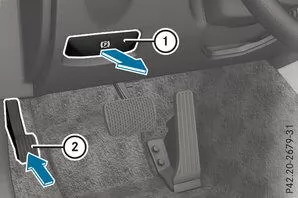
If you slow the vehicle using the parking brake, the brake lights do not illuminate.
Apply: Firmly press the parking brake pedal.
 in the instrument cluster is on.
Release: Press and hold the brake pedal.
On the release handlepull.goes out in the instrument cluster.The Mercedes E-Class W212 (model years 2009–2016) provides clear safety instructions for switching off the engine and using the parking brake. This reliably secures the vehicle against rolling away and minimizes the risk of accidents.
With these measures, the E-Class underlines its commitment to the highest level of safety, even when the vehicle is stationary.
Question: Why should the ignition not be switched off while driving?
Answer: Because important systems such as power steering and brake booster may fail.
Question: How is the vehicle secured against rolling away?
Answer: By applying the parking brake and, with manual transmission, engaging 1st or reverse gear; with automatic transmission, shifting to P.
Test yourself
A quick Mercedes-Benz E-Class quiz: every answer comes with an explanation and a link to the manual page.