Inspection 1. Visually inspect EVAP vapor lines for improper attachment and for cracks, damage, loose connections, chafing and deterioration. 2. Check EVAP canister as follows: a. Block port (A). Orally blow air through port (B). Check that air flows freely through port (C). b. Block port (B). Orally blow air through port (A).
Check that air flows freely through port (C).
3. Visually inspect the fuel check valve for cracks, damage, loose connections chafing and deterioration.
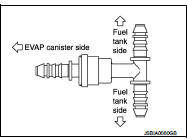
4. Check fuel check valve as follows: a. Blow air through connector on the fuel tank side. A considerable resistance should be felt and a portion of air flow should be directed toward the EVAP canister side. b. Blow air through connector on EVAP canister side. Air flow should be smoothly directed toward fuel tank side.
c. If fuel check valve is suspected or not properly functioning in step 1 and 2 above, replace it.
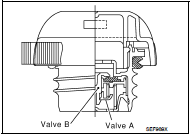
5. Inspect fuel tank filler cap vacuum relief valve for clogging, sticking, etc.
a. Wipe clean valve housing.
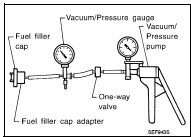
b. Check valve opening pressure and vacuum.
Pressure: 15.3 - 20.0 kPa (0.153 - 0.200 bar, 0.156 - 0.204 kg/ cm2, 2.22 - 2.90 psi) Vacuum: –6.0 to –3.4 kPa (–0.06 bar to –-0.034bar, –0.061 to – 0.035 kg/cm2, –0.87 to –0.49 psi)
c. If out of specification, replace fuel filler cap as an assembl