Driveline transfer: TY21B

System

In this manual: Driveline transfer: TY21B
Foreword — 1General information — 45Engine Mechanical MR16DDT — 61Engine Mechanical HR16DE — 52Engine Mechanical K9K — 46Engine Lubrication System MR16DDT — 18Engine Lubrication System HR16DE — 14Engine Lubrication System K9K — 11Engine Cooling System MR16DDT — 28Engine Cooling System HR16DE — 29Engine Cooling System K9K — 24Engine Control System MR16DDT — 163Engine Control System HR16DE — 115Engine Control System K9K — 129Fuel System MR16DDT — 13Fuel system HR16DE — 11Fuel system K9K — 12Exhaust system MR16DDT — 7Exhaust system HR16DE — 10Exhaust system K9K — 7Starting system — 24Accelerator control system — 6Clutch — 25Driveline transfer: TY21B — 77Driveline rear propeller Shaft: 3Fφ16-ETJ75 — 12Driveline rear final drive: RTVS — 31Transaxle & transmission 5MT: RS5F92R — 31Transaxle & transmission 6MT: RS6F94R — 30Transaxle & transmission CVT: RE0F10B — 93Transaxle & transmissioN CVT: RE0F11A — 103Front Axle MR16DDT — 18Front Axle HR16DE — 17Front Axle K9K — 17Rear Axle 2WD — 6Rear Axle 4WD — 13Front Suspension — 21Rear Suspension 2WD — 13Rear Suspension 4WD — 17Road Wheels & Tires — 6Brake System LHD — 24Brake System RHD — 24Parking Brake System — 8Brake Control System without ESP — 44Brake Control System with ESP — 63Steering System — 14Steering Control System — 27Seat Belt — 8SRS Airbag — 24SRS Airbag Control System — 93Ventilation System — 11Heater & Air Conditioning System HR16DE — 28Heater & Air Conditioning System MR16DDT — 28Heater & Air Conditioning Control System Type 1 — 49Heater & Air Conditioning Control System Type 2 — 51Heater & Air Conditioning Control System Type 3 — 32Heater & Air Conditioning Control System Type 4 — 40Heater & Air Conditioning Control System Type 5 — 21Interior — 16Instrument Panel — 10Seat — 18Door & Lock Type 1 — 83Door & Lock type 2 — 80Door & Lock type 3 — 65Door & Lock type 4 — 60Security Control System with intelligent key system — 82Security Control System without intelligent key system — 41Glass & Window System — 15Power Window Control System — 28Body Repair — 13Exterior — 20Mirrors — 26Exterior Lighting System Halogen type — 51Interior Lighting System — 24Wiper & Washer — 45Defogger — 31Horn — 4Power Outlet — 4Body Control System With intelligent key system — 21Body Control System Without intelligent key system — 23LAN system can fundamental — 6LAN system can — 31LAN System can system (type 1) — 1LAN System can system (type 2) — 1LAN System can system (type 3) — 1LAN System can system (type 4) — 1LAN System can system (type 5) — 1LAN System can system (type 6) — 1LAN System can system (type 7) — 2LAN System can system (type 8) — 1LAN System can system (type 9) — 1LAN System can system (type 10) — 1LAN System can system (type 11) — 1Power Control System IPDM E/R (with I-key) — 14Power Control System IPDM E/R (without I-key) — 14Power Control System Power distribution system — 25Charging System — 22Power Supply, Ground & Circuit Elements — 20Meter, Warning Lamp & Indicator — 33Warning Chime System — 22Audio, Visual & Navigation System Audio without navigation — 30Audio, Visual & Navigation System Audio with navigation — 33Audio, Visual & Navigation System NISSAN dynamic control system — 22Cruise Control System — 1Drive Mode System — 10Maintenance — 14
~3min read

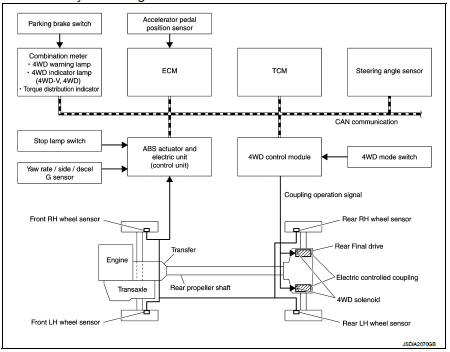
4WD system : System Diagram

INPUT/OUTPUT SIGNAL

INPUT/OUTPUT SIGNAL

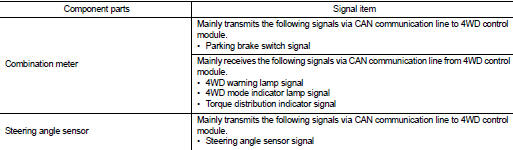
It transmits/receives each signal from the following 4WD control module via CAN communication line.

4WD system : System Description

4WD system : System Description

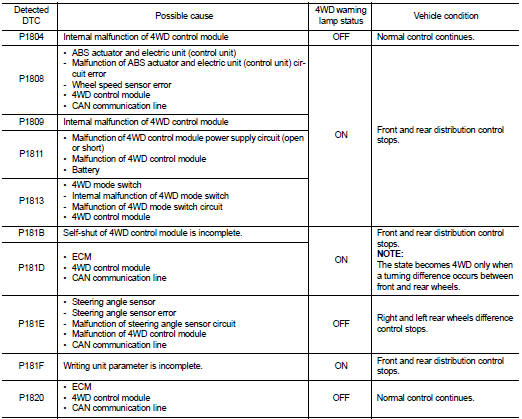
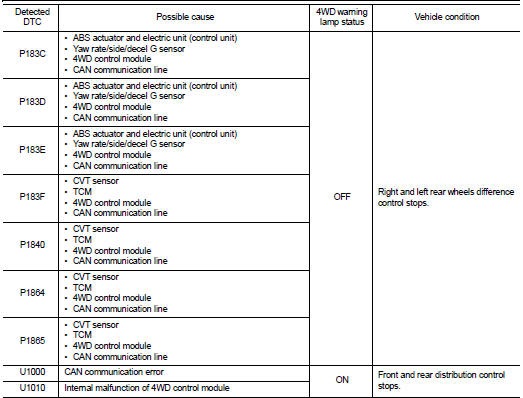
• 4WD mode is selectable among 2WD, 4WD-V, and 4WD by operating the 4WD mode switch. • When judging driving conditions and road surface conditions based on signals transmitted from each sensor and switch, the 4WD system automatically controls torque distribution of front and rear wheels and both rear wheels, depending on the situation. • In accordance with fail-safe function, when system is malfunctioning, 4WD control stops, and the system becomes rear wheel drive. Refer to DLN-19, "4WD SYSTEM : Fail-safe".

• When a high load status continues for electric controlled coupling, 4WD control temporarily becomes rear wheel drive, according to protection function. Refer to DLN-21, "4WD SYSTEM : Protection Function".

4WD system : Torque Split Control

2WD mode
• Vehicle is in front-wheel drive.

4WD-V mode
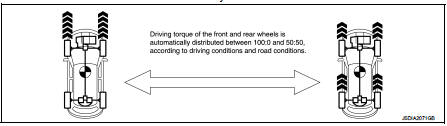
Normal Control
• Pressing force of multiple disc clutch is controlled by electric control. Driving torque distribution of front and rear wheels changes automatically between approximately 100 : 0 (Front wheel drive) and 50 : 50 (4WD) to have an optimized torque distribution adapted to road condition change. • When spin occurs on front wheel, distribute optimum torque to rear wheel and keep stable driving.

• On roads which do not require 4WD, it contributes to improved fuel economy by driving in conditions close to front-wheel drive and it results in better fuel efficiency.
Cornering Control

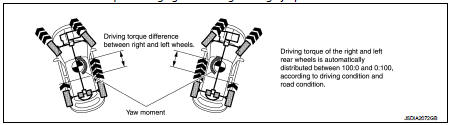
Cornering Control
• Torque between both rear wheels is automatically changed between 100 : 0 and 0 : 100 for distributing optimum torque that depends on the driving conditions and road surface conditions.

• Producing a difference between both rear wheels enables sporty and smooth handling.

• The vehicle cornering status is judged according to information from each sensor, and the optimum torque is distributed to rear wheels for preventing tight cornering/braking symptom.
4WD mode

4WD mode
• The 4WD mode controls torque for obtaining suitable torque for driving on slippery roads (e.g. snow-covered roads) and provides more stable driving, compared to 4WD-V.

4WD system : Fail-safe

When a system malfunction occurs, the 4WD warning lamp turns ON and the 4WD control becomes 2WD state.

4WD system : Protection Function

4WD system : Protection Function

4WD system activates its protection function (shuts down 4WD system temporarily) if 4WD system detects high load continuously, the front wheel tire size differs from the rear tire size or the rear RH wheel tire size differs from the rear LH tire size. (4WD system is automatically restored if 4WD system no longer detects any overload or the tire size difference is eliminated.)
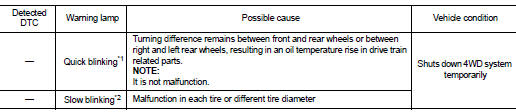
*1: 2 times/second (blinking for approximately 1 minute and then turned

*1: 2 times/second (blinking for approximately 1 minute and then turned OFF)
*2: 1 time/2 seconds (continuing to blink until ignition switch is turned OFF)

NOTE:
• If the warning lamp blinks slowly during driving but remains OFF after the engine is restarted, the system is normal. If it again blinks slowly after driving for some time, vehicle must be inspected.

• When there is a difference of revolution speed between the front and rear wheel the shift occasionally changes to direct 4-wheel driving conditions automatically. This is not a malfunction.