Types of child seats
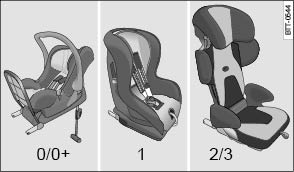 Fig. 57
Example illustration of child seats.
 Read and observe the introductory information
and safety warnings first⇒
 Introduction
to the topic
Only use child seats that are officially approved and suitable for the child.
Standards for child seatsIn the European Union, child seats are subject to Regulation ECE-R 44. Child seats tested to this standard bear the orange ECE approval label. The ECE approval label may include the following information about the child seat, among other things:
- Weight class,
- Size class,
- Approval category (universal, semi-universal or vehicle-specific),
- Approval number.
For child seats approved under Regulation ECE-R 44, the eight-digit approval number on the ECE approval label must begin with 03 or 04. This indicates that the seat is permitted. Older child seats whose approval number begins with 01 or 02 are not permitted.
Child seats by weight class| Class | Child's weight |
|---|---|
| Group 0 | up to 10 kg |
| Group 0+ | up to 13 kg |
| Group 1 | 9 to 18 kg |
| Group 2 | 15 to 25 kg |
| Group 3 | 22 to 36 kg |
- Weight class 0/0+: From birth until about 18 months of age, rear-facing infant seats ⇒ Fig. 57 of Group 0/0+ or 0/1 are most suitable.
- Weight class 1: Once the weight limit is reached, Group 1 child seats (up to about 4 years) or Group 1/2 child seats (up to about 7 years) with an integrated belt system are most suitable.
- Weight classes 2/3: Groups 2 and 3 include child seats with a backrest and booster seats without a backrest. Child seats with a backrest offer better protection than booster seats without a backrest, thanks to the integrated belt routing and the side padding. Volkswagen therefore recommends the use of child seats with a backrest. Group 2 child seats are suitable for the age group up to about 7 years, and Group 3 child seats from about 7 years.
Not every child fits the child seat for their weight group in the same way. Likewise, not every seat fits every vehicle. Always check whether the child fits correctly in the child seat and whether the child seat can be secured safely in the vehicle.
Child seats by approval categoryChild seats can have the approval category universal, semi-universal or vehicle-specific.
- Universal: Child seats with universal approval are approved for installation in all cars. A vehicle list is not required. For ISOFIX universal approval, the child seat must also be connected with a top tether.
- Semi-universal: Semi-universal approval requires, in addition to the standard requirements for universal approval, securing devices for the child seat that require additional tests. Child seats with semi-universal approval have a vehicle list that must include the vehicle.
- Vehicle-specific: Vehicle-specific approval requires a separate dynamic test of the child seat in the vehicle for each vehicle model. Child seats with vehicle-specific approval also have a vehicle list.