Special driving situations
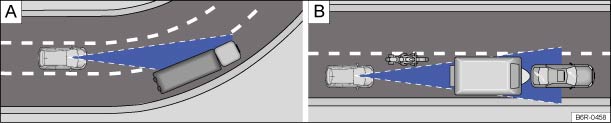 Fig. 109
: Vehicle in a curve.
: Motorcyclist driving ahead outside the operating range of the laser sensor.
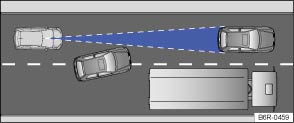 Fig. 110
Lane changes by other vehicles.
 Read and observe the introductory information
and safety warnings first⇒
 Introduction
to the topic
The City emergency braking function has physical and system-related limitations. For example, under certain conditions the reactions of the City emergency braking function may appear unexpected or delayed from the driver's point of view. Therefore, always remain attentive and intervene yourself if necessary!
For example, the following driving situations require special attention:
When corneringWhen entering or leaving long curves, the laser sensor may react to a vehicle in the adjacent lane ⇒ Fig. 109 and brake your own vehicle. The braking process
can be interrupted by accelerating, steering and depressing the clutch pedal.
Narrow vehicles and vehicles driving offset can only be detected by the laser sensor once they are within the detection range of the sensor ⇒ Fig. 109 . This applies in particular to narrow vehicles such as
motorcycles.
Vehicles that move into your lane at a short distance may trigger an unexpected braking intervention by City Emergency Braking ⇒ Fig. 110 . The braking process can be cancelled by accelerating, steering and pressing the clutch pedal.
Possible impairment of the laser sensorIf the function of the laser sensor is impaired, e.g. by heavy rain, spray, snow or mud, City Emergency Braking switches off temporarily. In the instrument cluster display, the indicator lamp flashes .
When the laser sensor is no longer impaired, City Emergency Braking automatically becomes ready for operation again. The indicator lampgoes out.
The following conditions may cause the City emergency braking function not to respond:
- When ESC intervenes.
- When cornering tightly.
- When reversing.
- When driving faster than approx. 30 km/h.
- When the accelerator pedal is fully depressed.
- When City Emergency Braking is switched off or malfunctioning ⇒ Warning and indicator lamps .
- If the laser sensor ⇒ Fig. 106 is dirty, covered or overheated.
- In snowfall, heavy rain or dense fog.
- With vehicles driving offset.
- With crossing vehicles.
- With oncoming vehicles in the same lane.
- With heavily soiled vehicles with low reflectivity.
- In heavy dust.