Fuel-saving driving
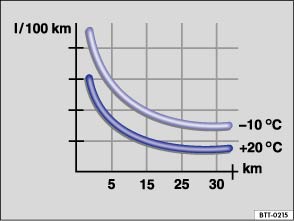 Fig. 102
Fuel consumption in l/100 km
at 2 different ambient temperatures.
 Read and observe the introductory information
and safety warnings first⇒
 Introduction
to the topic
When accelerating, a vehicle uses the most fuel. With anticipatory driving, less braking is needed and therefore less acceleration. Let the vehicle coast as far as possible, e.g. when you can see that the next traffic light is turning red.
Avoid short tripsA cold engine uses significantly more fuel immediately after starting. Only after a few kilometres is the engine at operating temperature and fuel consumption has returned to normal.
To effectively reduce fuel consumption and exhaust emissions, the engine and the catalytic converter must reach their optimal operating temperature. The ambient temperature is also decisive in this context.
⇒ Fig. 102 shows the different fuel consumption for the same route, once at +20 °C (+68 °F) and once at -10 °C (+14 °F).
Therefore, avoid unnecessary short trips and combine journeys.
Under the same conditions, the vehicle uses more fuel in winter than in summer.
Warming up the engine by idling is technically unnecessary and a waste of fuel. In some countries it is even prohibited by law.
Adjust tyre pressureWith the correct tyre pressure, rolling resistance and therefore fuel consumption are reduced.
When buying new tyres, always make sure they are low rolling resistance tyres ⇒ Information on wheels and tyres.
Use low-viscosity engine oilFully synthetic engine oils with a low viscosity, so-called low-viscosity engine oils, reduce fuel consumption. Low-viscosity engine oils reduce friction inside the engine and distribute more effectively and more quickly, especially during a cold start. The effect is particularly noticeable in vehicles that often make short trips.
Always check the correct engine oil level and observe the service intervals (engine oil change intervals).
When purchasing engine oil, always observe the engine oil specification and the Volkswagen approval.
Avoid unnecessary loadThe lighter a vehicle is, the more economical and environmentally friendly it is.
Remove all items that are not needed and any unnecessary load from the vehicle.
Remove unneeded body and attachment partsThe more aerodynamic a vehicle is, the lower its fuel consumption. Add-on parts such as roof racks or bicycle carriers reduce the aerodynamic advantage.
Therefore remove add-on parts that are not needed and roof rack systems that are not in use, especially if driving at high speeds is planned.