Jump starting
⇒ Jump starting the vehicle
If the engine will not start because the vehicle battery is discharged, the vehicle battery of another vehicle can be used to start it.
For jump starting, you need suitable jumper cables, e.g. to DIN 72553 (see the cable manufacturer's specifications). The cable cross-section must be at least 25 mm2 on vehicles with a gasoline engine and at least 35 mm2 on vehicles with a diesel engine.
Additional information and warnings:- Preparations for working in the engine compartment ⇒ Preparations for working in the engine compartment
- Vehicle battery ⇒ Vehicle battery

 Warning
Improper use of jumper cables and improper jump starting can cause the vehicle battery to explode and cause serious injury. To reduce the risk of an exploding vehicle battery, observe the following:
- All work on the vehicle battery and on the electrical system can cause serious chemical burns, fire or electric shock. Before any work on the vehicle battery, always read and observe the warnings and safety precautions ⇒ Vehicle battery.
- The donor vehicle battery must have the same voltage (12 volts) and approximately the same capacity (see the label on the vehicle battery) as the discharged vehicle battery.
- Never charge a frozen or thawed vehicle battery. A discharged vehicle battery can freeze at temperatures of around 0 °C.
- A frozen or thawed vehicle battery must be replaced.
- During jump starting, a highly explosive hydrogen gas mixture forms at the vehicle battery. Always keep sparks, open flames and fire away from the vehicle battery. Never use a mobile phone while connecting or disconnecting the jumper cables.
- Only charge the vehicle battery in well-ventilated areas, because a highly explosive hydrogen gas mixture forms at the vehicle battery during jump starting.
- Route the jumper cables so that they never come into contact with moving parts in the engine compartment.
- Never confuse the positive terminal with the negative terminal or connect the jumper cables incorrectly.
- Observe the operating instructions of the jumper cable manufacturer.

 Note
To avoid major damage to the vehicle's electrical system, observe the following:
- Improperly connected jumper cables can cause a short circuit.
- There must be no contact between the vehicles, otherwise current could flow as soon as the positive terminals are connected.
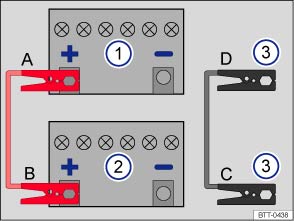 Fig. 168
Diagram for connecting the jumper cables
to the donor vehicle.
 Read and observe the introductory information
and safety warnings first⇒
 Introduction
to the topic
Key to ⇒ Fig. 168 :
 Vehicle with discharged vehicle battery
that receives jump start. Vehicle with the charged vehicle battery
that provides jump start. Suitable ground connection: Preferably the
jump-start point (ground connection); otherwise the front tow eye screwed in, a solid metal part firmly bolted to the engine block, or the engine block itself.
The discharged vehicle battery must be properly connected to the vehicle electrical system.
Before jump starting, check the battery test window on the vehicle battery if applicable ⇒ Vehicle battery.
The vehicles must not touch each other. Otherwise current could flow as soon as the positive terminals are connected.
Make sure the connected battery clamps make sufficient metallic contact.
If the engine does not start, stop cranking after 10 seconds and repeat after about one minute.
If the engine still does not start, seek assistance from a qualified workshop.
Connecting the jumper cablesConnect the jumper cables only in the sequence A – B – C – D ⇒ Fig. 168 .
- Switch off the ignition on both vehicles ⇒ Starting and stopping the engine.
- If fitted, open the vehicle battery cover in the engine compartment ⇒ Vehicle battery.
- Connect one end of the red jumper cable to the positive terminal (+) of the vehicle with the discharged vehicle battery ⇒ Fig. 168 ① ⇒ .
- Connect the other end of the red jumper cable to the positive terminal (+) of the charged vehicle battery that provides the jump start ⇒ Fig. 168 ②.
- Connect one end of the black jumper cable ⇒ Fig. 168 ③ preferably to a jump-start point (ground connection); otherwise to the front tow eye screwed in, to a solid metal part firmly bolted to the engine block, or to the engine block itself.
- Connect the other end of the black jump-start cable ⇒ Fig. 168 ③ on the vehicle with the discharged battery preferably to the jump-start point (ground connection); otherwise to the installed front towing eye ⇒ Towing and Tow-starting, or to a solid metal part firmly bolted to the engine block, or to the engine block itself ⇒ .
- Route the jump-start cables so that they cannot be caught by rotating parts in the engine compartment.
- Start the engine of the vehicle providing the power and let it idle.
- Start the engine of the vehicle with the discharged battery and wait 2 to 3 minutes until the engine runs smoothly.
- Before disconnecting the jump-start cables, switch off the low beams if they are on.
- On the vehicle with the discharged battery, switch on the blower of the air conditioning or heating and fresh-air system and the rear window heating so that voltage peaks occurring during disconnection are reduced.
- With the engines running, disconnect the jump-start cables only in the sequence D – C – B – A ⇒ Fig. 168.
- If necessary, close the battery cover.
- If necessary, unscrew the front towing eye ⇒ Towing and Tow-starting.
Warning Improper jump starting can cause the vehicle battery to explode and cause serious injury. To reduce the risk of an exploding vehicle battery, observe the following:
- All work on the vehicle battery and on the electrical system can cause serious chemical burns, fire or electric shock. Before any work on the vehicle battery, always read and observe the warnings and safety precautions ⇒ Vehicle battery.
- Always wear suitable eye protection and protective gloves, and never lean over the vehicle battery.
- Connect the cables in the correct sequence – positive cable first, then negative cable.
- Never connect the negative cable to fuel system components or brake lines.
- The non-insulated parts of the clamps must not touch each other. In addition, the cable connected to the positive terminal of the vehicle battery must not come into contact with electrically conductive vehicle parts.
- Check the battery test window, using a flashlight if necessary. If it is light yellow or colorless, do not jump-start and seek professional help.
- Avoid electrostatic discharges in the area of the vehicle battery. Sparks can ignite the oxyhydrogen gas escaping from the vehicle battery.
- Never jump-start if the vehicle battery is damaged, frozen or thawed.