Ispezione
1. ISPEZIONARE INTERRUTTORE SEDILE ANTERIORE ELETTRICO LH
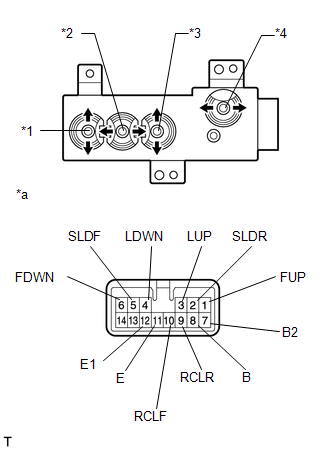
(a) Misurare la resistenza secondo i valori riportati nella tabella seguente.
Resistenza standard:
Interruttore Scorrimento
Collegamento del tester | Condizione dell'interruttore | Condizione specificata |
|---|---|---|
5 (SLDF) - 8 (B) 5 (SLDF) - 7 (B2) |
Anteriori |
Inferiore a 1 Ω |
2 (SLDR) - 11 (E) 2 (SLDR) - 12 (E1) |
||
5 (SLDF) - 11 (E) 5 (SLDF) - 12 (E1) |
Disattivato |
|
2 (SLDR) - 11 (E) 2 (SLDR) - 12 (E1) |
||
5 (SLDF) - 11 (E) 5 (SLDF) - 12 (E1) |
Posteriori |
|
2 (SLDR) - 8 (B) 2 (SLDR) - 7 (B2) |
Interruttore Verticale Anteriore
Collegamento del tester | Condizione dell'interruttore | Condizione specificata |
|---|---|---|
1 (FUP) - 8 (B) 1 (FUP) - 7 (B2) |
Su |
Inferiore a 1 Ω |
6 (FDWN) - 11 (E) 6 (FDWN) - 12 (E1) |
||
1 (FUP) - 11 (E) 1 (FUP) - 12 (E1) |
Disattivato |
|
6 (FDWN) - 11 (E) 6 (FDWN) - 12 (E1) |
||
1 (FUP) - 11 (E) 1 (FUP) - 12 (E1) |
Giù |
|
6 (FDWN) - 8 (B) 6 (FDWN) - 7 (B2) |
Interruttore Sollevatore
Collegamento del tester | Condizione dell'interruttore | Condizione specificata |
|---|---|---|
3 (LUP) - 8 (B) 3 (LUP) - 7 (B2) |
Su |
Inferiore a 1 Ω |
4 (LDWN) - 11 (E) 4 (LDWN) - 12 (E1) |
||
3 (LUP) - 11 (E) 3 (LUP) - 12 (E1) |
Disattivato |
|
4 (LDWN) - 11 (E) 4 (LDWN) - 12 (E1) |
||
3 (LUP) - 11 (E) 3 (LUP) - 12 (E1) |
Giù |
|
4 (LDWN) - 8 (B) 4 (LDWN) - 7 (B2) |
Interruttore Reclinazione
Collegamento del tester | Condizione dell'interruttore | Condizione specificata |
|---|---|---|
10 (RCLF) - 8 (B) 10 (RCLF) - 7 (B2) |
Anteriori |
Inferiore a 1 Ω |
9 (RCLR) - 11 (E) 9 (RCLR) - 12 (E1) |
||
10 (RCLF) - 11 (E) 10 (RCLF) - 12 (E1) |
Disattivato |
|
9 (RCLR) - 11 (E) 9 (RCLR) - 12 (E1) |
||
10 (RCLF) - 11 (E) 10 (RCLF) - 12 (E1) |
Posteriori |
|
9 (RCLR) - 8 (B) 9 (RCLR) - 7 (B2) |
Se il risultato non è quello specificato, sostituire l'interruttore sedile anteriore elettrico.
Testo nell'illustrazione*1 |
Interruttore Verticale Anteriore |
*2 |
Interruttore Scorrimento |
*3 |
Interruttore Sollevatore |
*4 |
Interruttore Reclinazione |
*a |
Componente senza cablaggio collegato (Interruttore Sedile Elettrico Anteriore) |
2. ISPEZIONARE INTERRUTTORE SEDILE ANTERIORE ELETTRICO RH
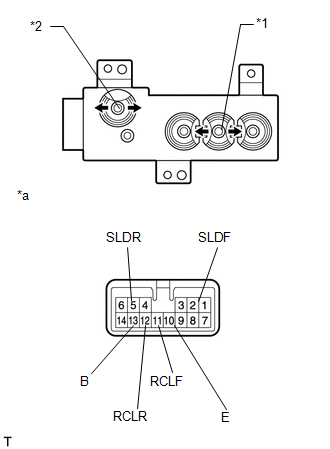
(a) Misurare la resistenza secondo i valori riportati nella tabella seguente.
Resistenza standard:
Interruttore Scorrimento
Collegamento del tester | Condizione dell'interruttore | Condizione specificata |
|---|---|---|
2 (SLDF) - 13 (B) |
Anteriori |
Inferiore a 1 Ω |
5 (SLDR) - 10 (E) |
||
2 (SLDF) - 10 (E) |
Disattivato |
|
5 (SLDR) - 10 (E) |
||
2 (SLDF) - 10 (E) |
Posteriori |
|
5 (SLDR) - 13 (B) |
Interruttore Reclinazione
Collegamento del tester | Condizione dell'interruttore | Condizione specificata |
|---|---|---|
11 (RCLF) - 13 (B) |
Anteriori |
Inferiore a 1 Ω |
12 (RCLR) - 10 (E) |
||
11 (RCLF) - 10 (E) |
Disattivato |
|
12 (RCLR) - 10 (E) |
||
11 (RCLF) - 10 (E) |
Posteriori |
|
12 (RCLR) - 13 (B) |
Se il risultato non è quello specificato, sostituire l'interruttore sedile anteriore elettrico.
Testo nell'illustrazione*1 |
Interruttore Scorrimento |
*2 |
Interruttore Reclinazione |
*a |
Componente senza cablaggio collegato (Interruttore Sedile Elettrico Anteriore) |
Mettiti alla prova
Un breve quiz sulla Toyota 4Runner: ogni risposta ha una spiegazione e un link alla pagina del manuale.