Adaptive Cargo Restraint System
The adaptive cargo restraint system is used to divide the luggage compartment space.
It consists of two brackets with a telescopic bar and tension straps. The brackets move along the luggage compartment floor tracks.
 Before using the adaptive cargo restraint system, raise and latch the rear seatback so that luggage cannot enter the passenger compartment.◄
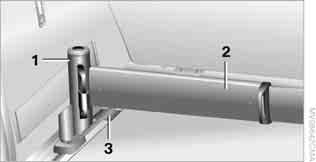
1 Bracket
2 Telescopic bar
3 Opening in the luggage compartment floor track
Installing the Brackets
Both brackets are connected to the telescopic bar.
1. Insert the brackets into the openings in the floor tracks.
2. Press the brackets down and move them to the required position.
3. Check that the brackets are secure. They must lock with a distinct click.
Do not place loads on the brackets, as the bracket locks may release under their weight.◄
Dividing the Luggage Compartment Space
The following luggage arrangements are possible:
► between the rear seatbacks and the telescopic bar
► between the telescopic bar and the tension strap
Securing luggage between the telescopic bar and the tension strap:
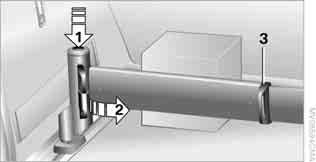
1. Place the luggage next to the telescopic bar. Press the button, see arrow 1, and pass the strap around the luggage, see arrow 2.
2. Secure the strap to buckle 3 on the telescopic bar.
3. Press the button on the bracket, see
arrow 1 – the strap tightens.
 Both straps can also be hooked together.◄
When the adaptive cargo restraint system is no longer needed, unhook the strap and let it retract into the bracket. To avoid damage and injury, hold the strap by its hook while doing so.
Then slide the restraint system forward to maximize luggage compartment capacity.
Removing the Brackets
Press the brackets down, slide them to the openings in the tracks and remove them.
Depending on vehicle equipment, the adaptive cargo restraint system can be stored in the compartment under the luggage compartment floor.
Test yourself
A quick BMW X3 quiz: every answer comes with an explanation and a link to the manual page.