How to Add Coolant to the Surge Tank
Coolant contains ethylene glycol and it will burn if the engine parts are hot enough. Do not spill coolant on a hot engine.
Notice: This vehicle has a specific coolant fill procedure.
Failure to follow this procedure could cause the engine to overheat and be severely damaged.
If coolant is needed, add the proper DEX-COOL coolant mixture at the coolant surge tank.
If no coolant is visible in the surge tank, add coolant as follows:
1. Remove the coolant surge tank pressure cap when the cooling system, including the coolant surge tank pressure cap and upper radiator hose, is no longer hot. Turn the pressure cap slowly counterclockwise about one-quarter turn and then stop.
If you hear a hiss, wait for that to stop. A hiss means there is still some pressure left.
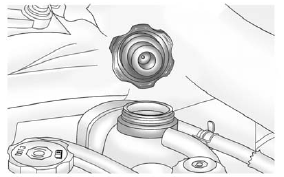
2. Keep turning the pressure cap slowly and remove it.
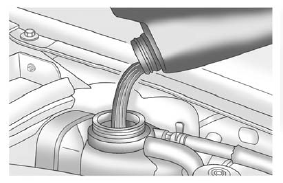
3. Fill the coolant surge tank with the proper mixture, to slightl y above the FROID/FULL COLD line on the side of the coolant surge tank.
4. With the coolant surge tank pressure cap off, start the engine and let it run until you can feel the upper radiator hose getting hot. The upper radiator hose is the top hose coming out of the radiator, on the passenger side of the vehicle. Watch out for the engine cooling fans.
By this time, the coolant level inside the coolant surge tank may be lower. If the level is lower, add more of the proper mixture to the coolant surge tank until the level reaches the FROID/FULL COLD line on the side of the coolant surge tank.
5. Replace the pressure cap.
Be sure the pressure cap is hand-tight and fully seated.
Notice: If the pressure cap is not tightly installed, coolant loss and possible engine damage may occur. Be sure the cap is properly and tightly secured.
Recheck the coolant level in the bottle next time you use your vehicle to ensure the system is full when cold.
Test yourself
A quick Cadillac CTS quiz: every answer comes with an explanation and a link to the manual page.