Recommended Fluids, Lubricants and Parts
Recommended Fluids and Lubricants
Use only products that have been tested and approved for use.
Damage caused by using unapproved operating materials is not covered by the warranty.
Warning Operating materials are hazardous substances and may be poisonous. Use caution when handling them. Follow the information on the product containers.Engine Oil
Engine oil is classified by quality and viscosity. When selecting engine oil, quality should be the primary consideration; viscosity is less important. Oil quality ensures, for example,
cleanliness of engine components, protection against wear, and control of oil aging, while the viscosity grade indicates the oil's density across temperature ranges.
dexos2TM Engine Oil Quality
Selecting the Correct Engine Oil
Selecting the correct engine oil depends on its specifications and viscosity grade.
Use and purchase only engine oils marked with the dexosTM certification symbol. Oils that meet the requirements of your vehicle should be marked with the dexosTM certification symbol on the container. This symbol indicates that the oil has been approved as meeting dexosTM specifications.
The vehicle was filled at the factory with engine oil that meets the dexosTM specification.
Use only engine oil approved as meeting dexosTM specifications, or an equivalent engine oil with the correct viscosity grade.
However, using oil that does not meet dexos specifications may in some situations lead to reduced performance and engine damage.
If you are not sure whether the oil you are using is approved as meeting dexosTM specifications, contact a service center.
Topping Up Engine Oil
Engine oils of different manufacturers and types may be mixed, provided both oils meet the quality and viscosity requirements for the engine.
If engine oil of the required quality is not available, you may add a maximum of 1 liter of ACEA A3/B4 or A3/B3 oil (one time only, until the next oil change).
Its viscosity should be at the required level.
Use of ACEA A1/B1 or A5/B5 oils is prohibited, because over the long term, under certain operating conditions, they may cause engine damage.
Engine Oil Additives
Using engine oil additives may lead to malfunctions and void the warranty.
Engine Oil Viscosity Grades
The SAE viscosity grade indicates the oil's density.
Multigrade oil is identified by two designations: The first designation, followed by the letter W, indicates viscosity at low temperatures, and the second designation indicates viscosity at high temperatures.
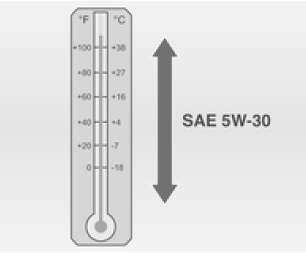
SAE 5W-30 is the best viscosity grade for this vehicle. Do not use oils with other viscosity grades, such as SAE 10W-30, 10W-40 or 20W-50.
Operation in low temperatures: In very cold regions where temperatures drop below -25°C, use SAE 0W-xx oil. Oil of this viscosity grade will make engine starting easier in extremely low temperatures.
When selecting oil of the appropriate viscosity grade, always choose oil that meets dexosTM specifications.
Temperatures down to -25°C: 5W-30, 5W-40
Temperatures down to -25°C and below: 0W-30, 0W-40
Coolant and Antifreeze
Use only long-life coolant (LLC), based on organic acid technology, with silicate-free corrosion inhibitors.
In temperate climates, the coolant provides freeze protection down to -35°C.
In cold climates, the coolant provides freeze protection down to -50°C. These properties must be maintained all year round.
Maintain the proper properties of the low-silicate coolant.
Coolant additives intended to provide extra corrosion protection or to seal small leaks may cause malfunctions.
Warranty claims related to the effects of coolant additives will be rejected.
Brake fluid
Use only brake fluid approved for this vehicle (DOT 4).
Over time, brake fluid absorbs moisture from the surroundings, which reduces brake system performance. For this reason, brake fluid must be replaced at specified intervals.
Store brake fluid in a tightly closed container (to prevent moisture absorption).
Make sure the brake fluid has not been contaminated.
Caution Using low-quality brake fluid may cause corrosion of internal brake system components and reduce brake system performance, which is a safety hazard. Always use high-quality brake fluid approved for your vehicle model.We recommend using genuine GM brake fluid.
Power Steering Fluid
Use Dexron VI fluid only.
Manual Transmission Oil
1.6 Petrol Engine: Use SAE 75W-90 fluid only.
Engines other than the 1.6 Petrol Engine: Use Castrol BOT 303 fluid only.
Automatic Transmission Fluid
Use Dexron VI fluid only.
Test yourself
A quick Chevrolet Aveo quiz: every answer comes with an explanation and a link to the manual page.