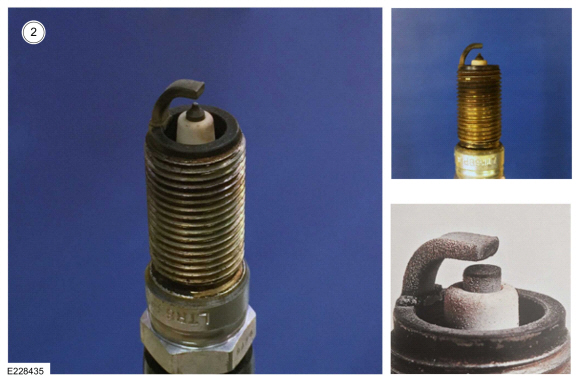
An unfired spark plug should look very clean, with a clean nickel plating on the threads and ground strap. The center electrode ceramic insulator surface often has a matte or dull finish and is pure white in color. The outer primary insulator is often polished white ceramic with the appropriate stamped labels. Some spark plugs have a smooth shell, while others have a ribbed insulator shell. Ford spark plugs almost always use a ribbed shell with glazed blue rib tips. The anti-fouling silicone oil treatment used on all Ford spark plugs may be colored pink. Some suppliers use this to indicate that silicone oil has been applied.
No corrective action is required.
Normal Combustion
A normally operating spark plug often has a white or slightly off-white (tan or light gray) color on the center electrode insulator and a clean or slightly discolored ground electrode.
No corrective action is required.
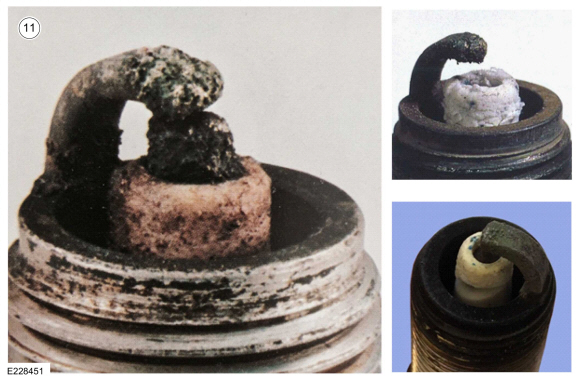
Carbon Fouling
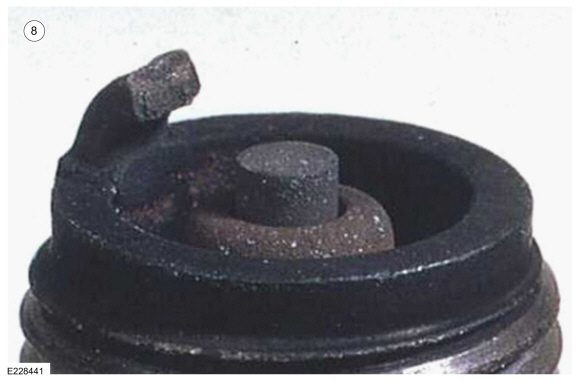
Carbon fouling can cause engine misfire. As carbon deposits formed by incomplete combustion adhere to the center electrode and insulator surface, the insulator's dielectric and insulation or shunt resistance is compromised. When enough carbon deposits are present on the center electrode and insulator surface, the primary conduction path can change from spark generation to a short circuit through the carbon deposits. This is also known as spark leakage. Due to the short circuit caused by carbon fouling, the voltage available at the center electrode tip is reduced until the spark is no longer delivered to the mixture and misfire occurs. Selecting the correct heat range is necessary to avoid preignition and carbon fouling. Even with the correct heat range, avoid excessive cold starts and/or excessive idling while the engine is cold without a warm-up cycle. For proper self-cleaning, be sure to heat the spark plug with a medium-load driving cycle. The normal operating temperature of a spark plug may be 450-850°C (842-1562°F), at which point carbon deposits burn off and the spark plug is self-cleaning.
A driving cycle with sufficient distance and engine speed can clean carbon fouling from the spark plugs (for example: 4 miles at 3000 rpm).
If this does not help, install new spark plugs.
Lead Fouling and Erosion
Lead fouling can occur in engines using leaded gasoline. In modern engines this failure mode is rare, since TEL (tetraethyl lead) was removed from consumer fuel some time ago. Lead fouling can occur in high-compression racing engines and, in some limited cases, aviation applications. Spark plugs exposed to lead are typically identified by a yellow-brown tinted center electrode insulator and can cause engine misfire at high engine speed and high load. In addition, ground electrodes are often worn in engines exposed to leaded fuel over a long period. This failure mode is caused by the tendency of lead compounds to react chemically with nickel electrode materials at high temperatures. These chemical reactions often cause increased brittleness and reduced strength of the ground electrode material.
Advise the customer to avoid using leaded fuel and/or octane-boosting additives.
Inspect the CMS (Catalyst Monitor Sensor) and HO2S sensor for signs of lead damage.
Install new spark plugs.
Wet Fouling from Coolant/Oil
Wet fouling most often results from excess fuel, oil, or coolant in the combustion chamber during operation. Spark plugs with wet fouling often cause hard starting and misfire. A wet-fouled spark plug often indicates additional mechanical problems in the engine, such as a damaged cylinder head gasket, oil leakage past the piston rings, or leakage in the valvetrain. In some cases, other causes may include low compression, vacuum leak, excessive ignition timing retard, or an incorrect spark plug heat range. The main cause of misfire is the low-resistance path created by oil, fuel, or coolant deposits. Wet deposits provide a lower-resistance path for spark leakage from the high-voltage center electrode to ground. Extended driving with coolant leakage may clean the plug.
Check for wet black deposits on the insulator and electrodes, with a hole in the shell caused by excessive oil entering the combustion chamber due to worn rings and pistons, excessive valve-to-guide clearance, or worn or loose bearings.
Repair the coolant or oil leak.
Install new spark plugs.
Deposit Buildup
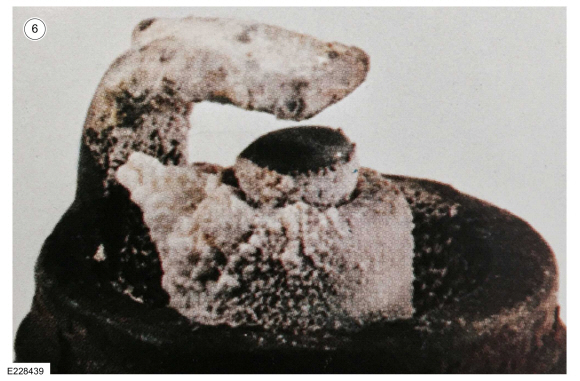
Deposits on the spark plug may indicate an oil leak or poor fuel quality. These ash coatings often cause misfire because a low-resistance path is created from the center electrode to ground.
If necessary, repair the oil leak.
Inform the customer of possible poor-quality fuel.
Install new spark plugs.
Abnormal Erosion/Corrosion/Oxidation
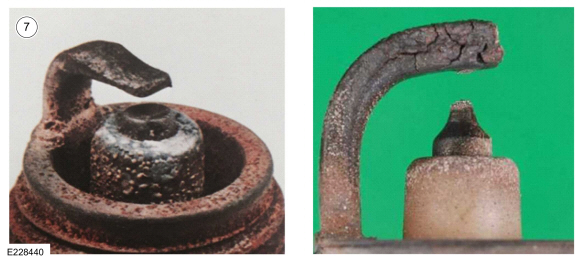
Erosion, corrosion or oxidation of the spark plug electrodes is often caused by leaded gasoline, which reacts with the electrode materials (see Lead Fouling). These symptoms appear as pits, cracked or eroded electrodes, and sometimes show a green glaze if copper oxidation is severe. These conditions cause an increased, irregular spark plug gap and poor performance. More recently, the use of E85 ethanol fuel blends (85% ethanol) can create this oxidation condition. The heat range selected for E85 applications is typically one range colder, due to the additional ignition timing advance used to compensate for the loss of performance. Hotter tip temperatures combined with rapid thermal cycling on the electrode surface initiate surface cracks and possible oxidation-based corrosion.
Make sure E85 is not used in a vehicle not designed for E85 use (flexible fuel vehicle).
Install new spark plugs.
Ground Electrode Breakage
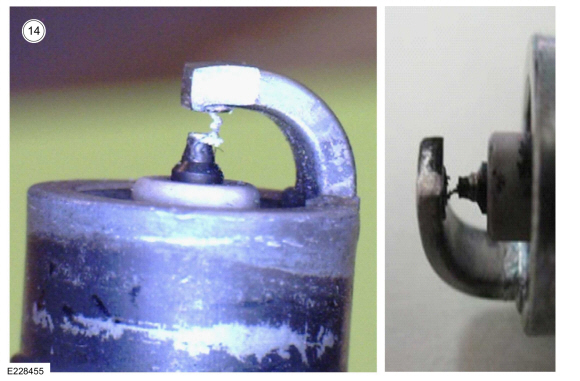
Ground electrode breakage may be caused by pre-ignition or any other excessive impact load. Breakage of the ground electrode may be caused by incorrect ignition timing, incorrect fuel type, or unauthorized installation of a Heli-Coil with reduced thermal conductivity inserted in place of the spark plug thread.
Check fuel supply and ignition timing.
Confirm the correct spark plug heat range.
Make sure the cylinder head threads have not been repaired using a Heli-Coil thread repair kit.
Install new spark plugs.
MMT Fouling (Hot Fouling)
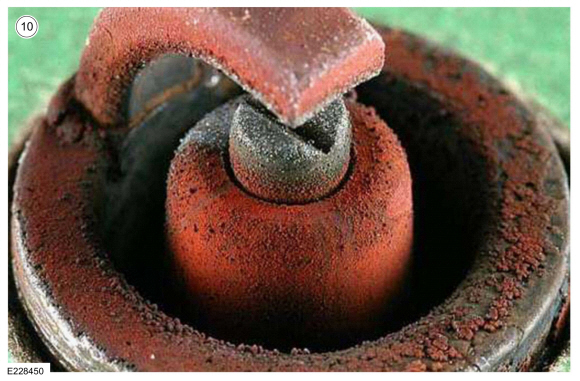
MMT (Methylcyclopentadienyl Manganese Tricarbonyl) is often used as an octane booster in combination with poor quality fuel to bring the octane rating within acceptable limits. If excessive Mn (manganese) levels are present in the fuel during combustion, manganese deposits can foul the combustion chamber, catalytic converters and spark plugs. Mn at higher concentrations can cause pre-ignition and engine misfire. Mn deposits become conductive when the surface exceeds ~550°C (1022°F). For this reason, the failure mode is called "Hot Fouling". Plug fouling. Because MMT has a high manganese content, a reddish deposit will be present on the spark plug insulator and side electrodes. The reddish coating is often covered with carbon deposits if the spark plug misfires.
Advise the customer to avoid using leaded fuel and/or octane-boosting additives.
Inspect the CMS and HO2S for MMT damage.
Install new spark plugs.
Ferrocene Fouling (Hot Replacement Fouling)
Ferrocene (a metallocene) is an organometallic compound often used instead of MMT as an octane-boosting additive. It is itself bright orange in color. If excessive ferrocene levels are present in the fuel during combustion, ferrocene deposits can foul the combustion chamber, catalytic converters and spark plugs. The deposit becomes conductive when the surface temperature exceeds ~450 °C. For this reason, the failure mode is referred to as Hot Replacement Fouling. Ferrocene at higher concentrations can cause pre-ignition and engine misfire.
Inform the customer that they may use leaded gasoline and/or an octane-boosting additive. Ask them to stop.
Inspect the CMS and HO2S oxygen sensor for ferrocene damage.
Install new spark plugs.
Overheating and Electrode Melting
Symptoms of overheating include white or light gray spots and a bluish-burnt appearance of the electrodes. These are caused by engine overheating, incorrect fuel type, loose spark plugs, spark plugs with an incorrect heat range, low fuel pump pressure, or incorrect ignition timing angle. Melted deposits are present with molten or spotty deposits resembling bubbles or blisters, and indicate sudden acceleration.
Check fuel supply and ignition timing angle.
Confirm the correct spark plug heat range.
Check the cooling system for leaks and blockages, and the water pump for malfunction.
Repair the cooling system and top up the coolant if necessary.
Install new spark plugs.
Insulator Damage and Breakage
Breakage of the center electrode insulator is often caused by sudden thermal shock from rapid heating or cooling. It may also be caused by mechanical load from an external source (dropping), or even by events preceding ignition, when the side load from combustion pressure shock waves is strong enough to break the insulator ceramic material. Spark plugs with a hotter heat range have a longer insulator life to reduce the risk of plug fouling, but are also weaker and break more easily during low-speed pre-ignition due to increased bending moment. Oil or sulfur oxide migration between the center electrode and the inner diameter of the insulator can create internal forces sufficient to form a U-shaped crack. See the Sodium/Oil Migration section for more information on this failure mode.
Install new spark plugs.
Sodium/Oil Migration
In case of oil migration, oil mist is drawn into the combustion chamber during intake charge. For a deactivated cylinder, the valves remain closed, and the oil in the chamber cannot burn. The oil mist adheres to the surfaces of the spark plug and the oil. It penetrates the gap between the insulator and the center electrode by capillary action. During cylinder reactivation, the oil near the surface burns off, forming carbon deposits (soot) within the gap volume due to incomplete combustion. During spark plug reheating, the center electrode thermally expands at a much higher rate than the insulator, causing compressive stress in the center electrode and tensile stress on the outer side of the electrode insulator. These stresses can cause the ceramic insulator to fracture if they are high enough. In sodium migration, sodium sulfate forms during combustion, and deposits form in the gap between the center electrode and the insulator. The source of sodium sulfate is currently unknown, although it is believed to originate from E100 fuel. The current theory suggests that failure is caused by electrode/insulator blocking, where the electrode and insulator are mechanically bonded by sodium sulfate. On cooling, the electrode contracts and its diameter increases, pressing (through the sodium sulfate) against the insulator and causing failure in the same manner as oil migration.
Install new spark plugs.
Bridging fracture
A shorted spark plug gap often results from fuel droplets present in the ion gap when the spark is delivered. The spark passes through the fuel droplet, leaving behind a carbon fiber. Other factors include the buildup of deposits on the electrode surface, indicating carbon or oil contamination. This condition often appears after many cycles of low and medium load. Carbon deposits inside the combustion chamber may be dislodged during sudden high-load application, lodge in the spark plug gap, and cause a complete short circuit to ground.
Install new spark plugs.
After driving 4 to 10 miles at 3000 rpm, the plug will reach its self-cleaning temperature.
Cracking caused by wrench breakage
Cracks caused by wrench breakage usually result either from side loading or from torque applied to a socket of the wrong size. Impact loading can, and often does, cause cracking of the insulator shell. Porcelain is very brittle with very low tensile strength. The direction of force can often be easily determined, as ceramic often cracks vertically (although usually asymmetrically about the centerline).
Avoid using anything other than a spark plug socket and hand tools to better prevent these cracks.
Install new spark plugs.
Tracking/Erosion
Tracking marks are marks left after a high-voltage discharge occurs from the electrode to ground through something other than the air gap at the spark plug tip. Most often these discharges occur along the main insulator (under/next to the boot) and on the center electrode insulator. These discharges typically scorch the porcelain ceramic and leave a brown, burnt visual indicator. The first photo shows a large brown scorch mark. In the second, upper photo, tracking traces are visible along each rib. In the lower secondary photo, showing a typical case of carbon fouling, tracking marks are present along the insulator of the center electrode, as the spark current followed along the insulator until it jumped sideways to the metal shell.
Install new spark plugs.
Install a new ignition coil boot (if tracking is above the hex).
If tracking is present above the hex, both of the above parts must be replaced at the same time, because the tracking is present on both components. If only one is replaced, the problem will persist and a repeat visit is very likely.
Corona spot
A brown spot near the junction of the insulator and the metal shell of the spark plug is often called a corona spot and forms when oil particles present in the air near the engine adhere to the insulator surface. Corona discharge occurs when high voltage applied to the conductor at the top of the spark plug causes breakdown of the air gap between the insulator and the metal shell. A corona spot does not affect spark plug operation. In the upper right corner of the photo, tracking traces are present, indicating flashover over the ribs, but stopping as soon as corona discoloration is reached. This suggests that a corona spot does not conduct current even in the presence of high kilovolts during normal operation. The lower right photo shows a corona spot on the inside of the boot.
No corrective action is required if only a corona spot is present.
Bent/broken center electrode due to pre-ignition events (Rattler)
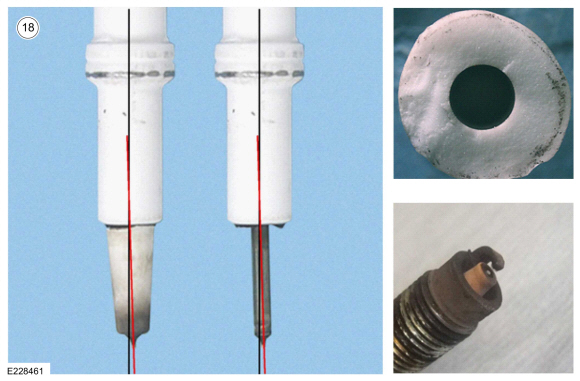
Under extreme pre-ignition events, the shock wave traveling through the combustion chamber can bend the center electrode and break the porcelain center electrode insulator. Under these extreme conditions, a "rattler" can form where the center electrode separates from the spark plug and rattles from vibration. In the main photo, the bent center electrode is highlighted, while the upper secondary photo shows the fracture surface of the broken insulator, and the lower secondary photo shows a spark plug with a detached center electrode insulator.
Install new spark plugs.
Corrosion (water damage)
Corrosion found on the threaded/hex area may indicate that the spark plug has been exposed to moisture and heat. This condition often occurs when water has entered the spark plug tube seals and into the spark plug well. In many cases, this corroded spark plug also exhibits misfire symptoms (because water provides a low-resistance path from the ignition coil to ground), and the combustion chamber interface (center electrode and ground strap) is often heavily fouled with carbon.
Check the source of water intrusion and repair as necessary.
Install new spark plugs.
Install a new ignition coil and boot assembly.
Advise the customer to avoid direct water spray on the ignition coil covers.
?
Test yourself
A quick Ford Fusion quiz: every answer comes with an explanation and a link to the manual page.