Emission Control System
Description and Operation
In this manual: Emission Control System
~1min read
Description
The evaporative emission control system prevents fuel vapors stored in the fuel tank from escaping into the atmosphere. When fuel evaporates in the fuel tank, the vapor passes through vent hoses or tubes to the charcoal canister. The canister temporarily holds the fuel vapors in charcoal. The ECM controls the system to draw the stored vapor into the combustion chambers under certain operating conditions. Intake manifold vacuum is used to draw the vapor into the intake manifold.Operation
Evaporative System Monitoring
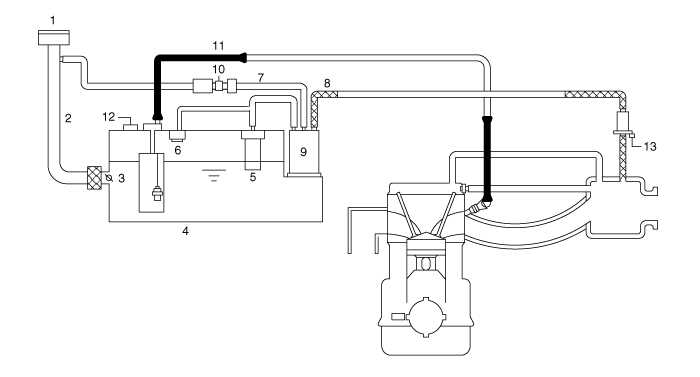
| 1. Fuel Tank Cap 2. Filler Neck 3. Fuel Cut-Off Valve 4. Fuel Tank 5. ORVR Valve 6. 2-Way and Roll-Over Valve 7. Evaporative Hose |
8. Evaporative Hose 9. Charcoal Canister 10. Canister Close Valve (CCV) 11. Fuel Feed Line 12. Fuel Tank Pressure Sensor (FTPS) 13. Purge Control Solenoid Valve (PCSV) |
Test yourself
A quick Hyundai Elantra AD quiz: every answer comes with an explanation and a link to the manual page.
Was this page helpful?