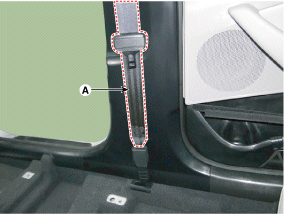
The Emergency Fastening Device (EFD) works together with the seat belt pretensioner when deployment is required after a collision. It is an auxiliary device that prevents the driver and passengers from being released by pulling the seat belt toward the anchor point after a collision. It is located near the anchor point of the driver and passenger seats and is supported by two cables.
Repair Procedures
DEPOSIT
Disconnect the negative battery cable and wait at least 3 minutes before starting work.
Remove the front seat. (Refer to Body - "Front Seat")
Remove the rear seat. (Refer to Body - Rear Seat)
Remove the front seat belt anchor (A).
Tools to use: Tool A: hex-head screwdriver or 3 mm drill bit 56 mm long or longer. Tool B: screwdriver or 3 mm drill.
Insert tool (A) vertically into hole (F). Then tilt it more than 10°, as shown in the illustration.
Insert and press tool (B) vertically into hole (E). The seat belt anchor connector (D) is then disconnected.
Remove the door scuff plate. (Refer to Body group - Interior Trim.)
Remove the center pillar trim. (Refer to Body group - Interior Trim.)
Remove all carpet from the floor. (Refer to Body - "Carpets")
Disconnect the anchor pretensioner (A).
Loosen the locking bolt and remove the anchor pretensioner.
REMEDY
Disconnect the negative battery cable, then wait at least 3 minutes.
Install the EFD system with the mounting bolt.
Tightening torque: 39.2 ~ 54 N·m
Connect the emergency fastening device connector (A).
Connect the battery negative cable.
After installing the EFD system, make sure it operates correctly: Turn the ignition ON. The SRS warning light should illuminate for about six seconds, then turn OFF.
?
Test yourself
A quick Hyundai Tucson quiz: every answer comes with an explanation and a link to the manual page.