Engine Mechanical System
Engine Oil Repair Procedures
In this manual: Engine Mechanical System
13steps
~83min
4/5difficulty
1special tools
Done 0 of 13
Oil and Filter Replacement
|

- Park the vehicle on a level surface.
- Drain the engine oil.
- Remove the oil filler cap.
- With the vehicle raised, remove the oil drain plug and drain the oil into a container.
- Replace the oil filter (A).
- Using SST (09263-2E000), remove the oil filter.
- Inspect and clean the oil filter installation surface.
- Make sure the part number of the new oil filter is the same as the old one.
- Apply clean engine oil to the gasket of the new oil filter.
- Lightly screw the oil filter into place, then tighten it until the gasket contacts the seat.
- Tighten it to the torque specified below.
Tightening torque: 11.8 ~ 15.7 N·m
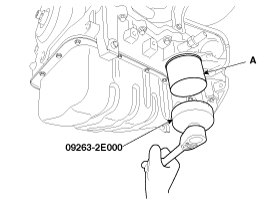
- Install the drain plug with a new gasket.
Tightening torque: 34.3 ~ 44 N·m
- Refill with new engine oil after removing the oil level sensor. Total capacity: 4.5 L (1.19 US gal, 4.76 US qt, 3.96 liters) Oil pan: 3.7 L (0.98 US gal, 3.91 US qt, 3.26 liters) Drain and refill, including oil filter: 4 L (1.06 US gal, 4.23 US qt, 3.52 liters)
- Install the oil filler cap.
- Start the engine and check for oil leaks, and check the oil level sensor or oil pressure indicator.
- Recheck the engine oil level.
Inspection
- Check the engine oil quality. Check for oil deterioration, water contamination, discoloration or dilution. If the quality is clearly poor, replace the oil.
- Check the engine oil level. After warming up the engine, stop the engine, wait 5 minutes, then check the oil level. The oil level should be between the "L" and "F" marks on the dipstick. If the level is low, check for leaks and add oil up to the "F" mark.
Do not overfill the engine oil above the "F" mark.
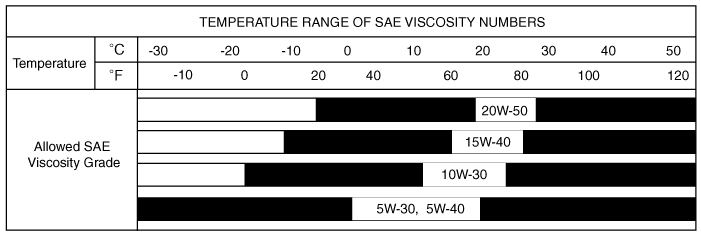
- ACEA A5 or higher / 5W-30
- API SL, SM or higher
- ILSAC GF-3, GF-4 or higher
- ACEA A3, A5 or higher
|
Test yourself
A quick Hyundai Tucson LM quiz: every answer comes with an explanation and a link to the manual page.
Was this page helpful?