For Safe All-Wheel Drive Operation
Before Driving
- Make sure all passengers are wearing their seat belts.
- Sit upright and closer to the steering wheel than usual. Adjust the steering wheel to a comfortable position.
Driving on Snowy or Icy Roads
- Start slowly by gently depressing the accelerator pedal.
- Use winter tires or tire chains.
- Maintain a safe following distance between your vehicle and the vehicle ahead of you.
- Use engine braking when decelerating.
- Avoid excessive speed, rapid acceleration, sudden braking, and sharp turns to prevent skidding.
Driving on Sand or Mud
- Maintain a slow and steady speed.
- If necessary, use tire chains when driving on muddy roads.
- Maintain a safe following distance between your vehicle and the vehicle ahead of you.
- Reduce vehicle speed and always check road conditions.
- Avoid excessive speed, rapid acceleration, sudden braking, and sharp turns to avoid getting stuck.
CAUTION
If the vehicle is stuck in snow, sand, or mud, place non-slip material under the drive wheels to provide traction, OR slowly rock the wheels back and forth, which creates a rocking motion that may free the vehicle. However, avoid running the engine continuously at high speed, as this may damage the all-wheel drive system.
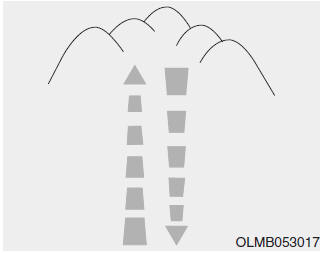
Driving Uphill or Downhill
- Driving uphill: Before starting, check whether you can drive uphill. Drive as straight as possible.
- Driving downhill: Do not shift gears while driving downhill. Select the gear before starting the descent. Drive slowly, using engine braking when descending the slope. Drive as straight as possible.
WARNING
Exercise extreme caution when driving up or down steep slopes. The vehicle may overturn depending on the gradient, terrain, and water/mud conditions.
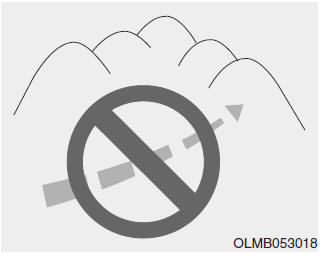
WARNING
Do not drive across the contour of steep hills. A small change in wheel angle may destabilize the vehicle, or a stable vehicle may lose stability if it stops moving forward. Your vehicle may overturn, resulting in serious injury or death.
Driving Through Water
- Avoid driving through deep standing water. This may stall the engine and cause water to enter the exhaust pipes.
- If you must drive through water, stop the vehicle, shift the all-wheel drive mode to LOCK, and drive at a speed below 5 mph (8 km/h).
- Do not shift gears while driving through water.
CAUTION
Always drive slowly through water. If you drive too fast, water may enter the engine compartment and wet the ignition system, causing your vehicle to stall suddenly. Do not stop.
Additional Driving Conditions
- Before driving, familiarize yourself with off-road conditions.
- Always be attentive when driving off-road and avoid hazardous areas.
- Drive slowly in strong winds.
- Reduce vehicle speed when cornering. The center of gravity of 4WD vehicles is higher than that of regular vehicles, which increases the likelihood of rollover when turning quickly.

Always hold the steering wheel firmly when driving off-road.
WARNING
Do not grip the inside of the steering wheel rim when driving off-road. Your hand may be injured by sudden steering wheel kickback or by impact with objects on the ground. You may lose control of the steering wheel, which may result in serious injury or death.
Test yourself
A quick Hyundai Tucson LM quiz: every answer comes with an explanation and a link to the manual page.