Description and operation
Description
The optimum seat position set by the driver is memorized in the power seat unit by IMS switch control to be recalled by using the IMS switch even if the seat position has been changed.
It is equipped with safety functions such as prohibition of recalling and emergency stopping of linked motion while driving.
The main functions are as follows.
Manual operation: Motor control with the seat manual switch
The position of the seat is changed by operating the motor when the signal is input with manual switch for the seat (Slide, recline, front tilt, rear height adjusting)
Memory function : Can memorize and recall data for up to two persons with IMS switch.
Memorized operations of seat and outside rearview mirror positions are operated by IMS switch via CAN (IMS > DDM) when the optimum seat position is set by the driver.
Recall by the CAN data received from IMS switch control.
Linked motion for getting on/off
Linked motion for getting on/off depending on the ON/OFF state of the engine
Uses IMS CAN data communication
Operating condition for getting on : ACC ON
Operating condition for getting off : Engine OFF
Memorization and recalling of mirror position using memory switch
System Description
IMS switch inputs are received at Power Seat Module (PSM).
On receiving IMS switch input, the PSM will send the information to DDM and ADM via CAN.
On receiving the information from the PSM, the DDM and the ADM will memorize and restore it.
Memorization and recall are performed if the following conditions are met:
IGN ON
Gear in P (Park)
The vehicle speed is 0 km/h according to the information transmitted from the BCM via CAN.
Mirror Position Memorization
Move the driver side and passenger side outside rearview mirrors to desired positions.
Press the SET switch from IMS switches.
Press switch 1 or 2 for a set period of time.
The mirror positions will be stored in the IMS switch 1 or 2 of the DDM and the ADM.
Operation
Recall operation
The buzzer will operate once and automatically be adjusted to the memorized position when the CAN data from IMS is received.
Unsaved recall signals will not be performed.
If another recall signal is received during recall operation, the last received recall signal prevails.
If recall signal is received by pressing switch 1 or 2 during recall operation, the seat will stop recall operation.
If memory signal is received by pressing SET button during recall operation, the seat will stop the recall operation.
Automatically stop at the virtual limit position during recall operation.
If the difference between memorized position and current position is less than 4 pulses, motor will not be operated.
Conditions for prohibiting recall operation
Recall operation is prohibited and recall operation is stopped if any of the following conditions is met.
IGN2 OFF (except within 30 seconds of opening or closing door)
Over 3 km/h of vehicle speed
In case of manual switch manipulation
Operation time chart
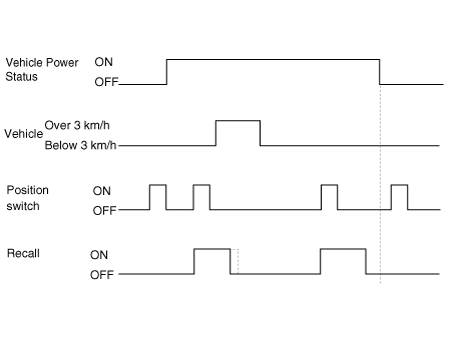
Decision on the operation priority
The motor operation shall be delayed for 100±10 milliseconds to prevent the overlapping of inrush circuit during motor start. In this case, the priority is as follows.
Slide > Backrest adjustment >Front height adjustment >Rear height adjustment
Operation time chart
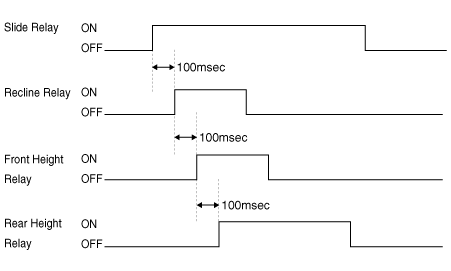
Operation linked with getting on/getting off
Return operations backwards when getting off and forward when getting on (slide type only)
Starting of operation when the engine is off.
Move to the target potision of ACC ON.
Condition for prohibiting operation
Over 3 km/h of vehicle speed
In case of power seat manual control switch manipulation
On receiving recall command during operation for getting on
Driver Settings Manu (USM) is Off
Virtual Limit
Virtual Limit Setting Conditions and Positions
Set an arbitrary virtual limit using any of the methods below since there is no separate switch limiting the operations of slide, backrest and front / rear height adjusting motors:
Slide recall: When there is no slide motor pulse inputted (mechanical end stop) through 6 or more pulses for 2 seconds during any operation triggered by a manual switch and memory recall operation, stop the motor immediately and set a position ahead of 6 pulses away from the position as the limit position in the driving direction (same for the opposite limit setting).
Set position Virtual Limit Setting Conditions Virtual Limit Setting Positions Slide 2 seconds, 6 pulses 6 pulses from restricted position Backrest adjustment (recline) 2 seconds, 155 pulses 155 pulses from restricted position Front tilt 1 second, 6 pulses 6 pulses from restricted position Rear height adjustment 1.5 seconds, 6 pulses 6 pulses from restricted position
? Pulse : A waveform unit to measure revolution of a motor
Once a virtual limit has been set, do not perform any memory recall operation to a position out of the limit range, in order to prevent motor damage due to kinematic locking.
Renew the limit position if a pulse is normally inputted out of that position by memory manipulation with the limit set.
Virtual Limit Setting Procedure
Slide : To set a virtual limit, move a seat forwards to the end stop, hold it for 2 seconds, move it rearwards to the end, and then hold it for 2 seconds.
Backrest adjustment (recline) : To set a virtual limit, move a backrest forwards to the end stop, hold it for 2 seconds, move it rearwards to the end, and then hold it for 2 seconds.
Front tilt : To set a virtual limit, move a seat upwards to the end stop, hold it for 1 second, move it downwards to the end, and then hold it for 1 second.
Rear height adjustment : To set a virtual limit, move a seat upwards to the end stop, hold it for 1.5 seconds, move it downwards to the end, and then hold it for 1.5 seconds.