Towing
When towing the Kia Opirus, safety and correct procedure have the highest priority. It is recommended to seek professional assistance to avoid damage to the suspension or transmission, especially on vehicles with automatic transmission. This chapter provides clear instructions for emergencies, such as using the towing eyes, shifting to neutral or correctly securing ropes. Common towing mistakes are also covered, making it essential reading for all owners.
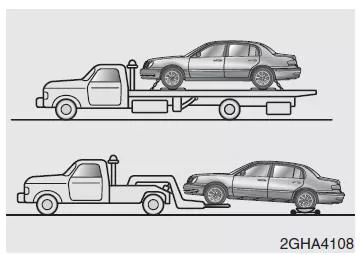
It is recommended that towing be carried out by a KIA authorised dealer or a commercial towing service. To avoid damage to the vehicle during towing, suitable and proper towing procedures must be used.

The vehicle can be towed on the rear axle either with or without a dolly.
If the vehicle is to be towed with one axle on the ground, the front must be raised. Do not tow the vehicle with the front wheels on the ground.
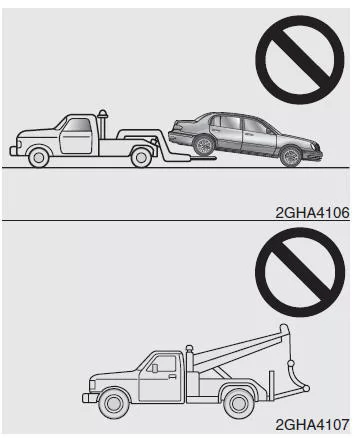
NOTE
- Never tow the vehicle backwards with the front wheels on the ground. The vehicle could be damaged as a result.
- Do not use a sling strap device for towing. Have your vehicle towed only on a flatbed truck or with a wheel lift.
If your vehicle must be towed in an emergency with the front wheels on the ground, proceed as follows:
1. Turn the ignition key to the ACC position.
2. Move the gear selector lever to neutral (N).
3. Release the parking brake.
CAUTIONIf the selector lever of the automatic transmission is not in position N (neutral) when towing with the front wheels on the ground, the automatic transmission may be internally damaged.
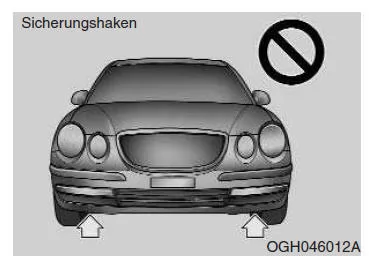
Tie-down hooks
WARNINGNever use the tie-down hooks at the front underneath the vehicle for towing. These hooks are intended ONLY for securing the vehicle during transport, e.g. on a truck.
If the tie-down hooks are used for towing, this may damage the vehicle and cause serious injury.

Towing without a tow truck
If your vehicle needs to be towed, we recommend having this done by an authorised KIA dealer or a recognised towing service.
If no towing service is available in an emergency, your vehicle can be towed temporarily using a tow rope or tow bar. A towing eye is provided at both the front and the rear.
Take particular care when towing a vehicle in this way or when having your vehicle towed.
Tow a vehicle in this way only on paved roads, at low speed and for short distances.
Only tow a vehicle in this way if its wheels, axles, drivetrain, steering and brakes are in proper working order.
- Do not attempt to tow your vehicle if its wheels are stuck in mud, sand or otherwise so that the vehicle cannot be driven out under its own power.
- Avoid towing a vehicle that is heavier than the towing vehicle.
- The drivers of both vehicles should communicate regularly with each other (eye contact).
Exercise extreme caution when towing a vehicle.
- Pull away slowly and smoothly, and drive at a steady speed so that the towing eye and tow rope are not overloaded unnecessarily. If the towing eye breaks or the tow rope tears, this could cause damage to property and personal injury.
- If the stuck vehicle barely moves, do not continue towing by force. Call an authorised KIA dealer or a roadside assistance service.
- Always tow the vehicle being towed in as straight a line as possible.
- Make sure no persons are within the danger zone during towing.
- Attach a tow rope to the towing eye.
- Never attach a tow rope to any vehicle part other than the front or rear towing eye, to avoid vehicle damage.
- Use only a tow rope that is designed and approved for this purpose, and attach the tow rope securely to the towing eye.
- Before towing, check that the towing eye is in proper condition.
- Attach the tow rope or tow bar securely to the towing eye.
- Do not apply sudden loads to the towing eye. Apply the load to the eye evenly.
- To avoid damaging the towing eye, do not pull the towed vehicle at an angle or to the side when starting off. Pull straight ahead.
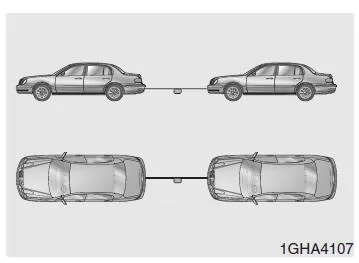
- Use a tow rope that is no longer than 5 m.
Attach a white or red cloth approx. 30 cm wide to the middle of the tow rope so that the rope cannot be overlooked.
- Drive carefully and make sure the tow rope always remains taut.
If your vehicle must be towed with a tow rope in an emergency
- Turn the ignition key to the ACC position so that the steering column lock is released.
- Move the gear selector lever to the Neutral position N.
- Release the parking brake.
- Vehicles with an automatic transmission should not be towed faster than 45 km/h and not farther than 80 km.
- Press the brake pedal harder than normal, because brake servo assistance is not available when the engine is off.
- More steering effort is required, because power steering assistance is not available when the engine is off.
- If you drive downhill for a long time, the brakes can overheat and their braking effect can decrease.
Stop frequently and let the brakes cool down.
To avoid damage to the transmission, never tow your vehicle backwards when all four wheels are in contact with the ground.
General Tips for Freeing a Stuck Vehicle
The following notes can help you tow a vehicle free that is stuck in mud, sand or other conditions so that it cannot drive itself free.
- Remove soil and sand in front of and behind the wheels of the stuck vehicle.
- Try to place a stone or a piece of wood as far as possible under the wheels.
- Have your vehicle pulled out of mud, sand, etc. only by a suitable towing vehicle using appropriate equipment.
- Keep children and other persons out of the danger zone of the towing vehicle.
Towing the Kia Opirus 2003–2011 requires care and the use of suitable procedures to avoid damage. The manufacturer recommends professional towing services or a flatbed truck for maximum safety.
It is especially important to use the designated towing eyes and to observe the instructions on gear position and driving speed. This keeps the Kia Opirus reliably protected even in emergency situations.
FAQWhy must the Kia Opirus not be towed backwards on its front wheels?
Because this could damage the automatic transmission.
What speed must not be exceeded when towing?
Maximum 45 km/h for vehicles with an automatic transmission on short distances.
Test yourself
A quick Kia Opirus quiz: every answer comes with an explanation and a link to the manual page.