Warning signals. Engine overheating
Hazard warning lights and engine overheating are critical topics for the Kia Opirus. This chapter explains how warning signals are activated and which steps must be followed in case of signs of overheating – including safety information on the cooling system. Particularly important: never open the radiator cap when the engine is hot. This chapter provides clear instructions for various scenarios and thus helps prevent consequential damage.
Warning signals
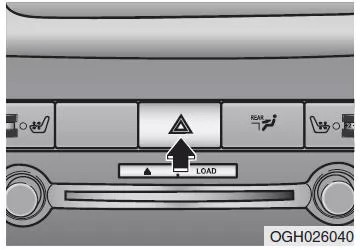
Hazard warning flashers
The hazard warning lights are a warning signal to other road users in special situations, such as in the event of a breakdown, so that they can take extra care when approaching, overtaking or passing. Switch on the hazard warning lights if you have to stop due to a breakdown or if you have to stop in an unfavorable location, e.g. in an intersection area.
The hazard warning lights can be operated at any time, regardless of the position of the ignition key. The hazard warning switch is located in the center switch console. After pressing the hazard warning switch, all turn signal lights flash simultaneously.
- The hazard warning lights work with the engine running as well as with the engine stopped.
- When the hazard warning lights are switched on, the turn signals cannot be switched on at the same time.
- Be very careful when the vehicle is towed with the hazard warning lights switched on.
Engine overheating
If the coolant temperature indicator shows overheating, if a loss of power is noticeable or if loud knocking or pinging noises can be heard, the engine may be overheating. If any of the above symptoms occur, please proceed as follows:
1. Switch on the hazard warning lights and stop at the next safe opportunity. Move the automatic transmission selector lever to the park position P and apply the parking brake.
2. Make sure the air conditioning is switched off.
3. Switch off the engine if boiling coolant or steam escapes from the radiator, and call an authorized KIA dealer or a breakdown service for assistance.
If the radiator is not boiling over, let the engine run at idle and open the hood so that the engine can gradually cool down.
If the coolant temperature does not drop while the engine is running at idle, switch off the engine and wait until it has cooled down.
4. Check the engine coolant level afterward. If the coolant level in the reservoir is too low, check the coolant and heater hoses, including their connections, the radiator, and the coolant pump for leaks. Do not restart the engine if you find a major leak or another problem that could have caused the overheating.
Call an authorized KIA dealer or roadside assistance and have the damage repaired before continuing. If you cannot find a leak or another problem, carefully add engine coolant to the reservoir.
CAUTION - Removing the radiator capDo not remove the radiator cap while the engine and radiator are still hot.
Boiling hot coolant as well as hot steam can escape from the radiator under pressure. There is a risk of scalding.
If the engine overheats frequently, have the cooling system inspected and repaired by an authorized KIA dealer.
The warning signals of the Kia Opirus 2003–2011, such as the hazard warning lights, help warn other road users in the event of a breakdown. They increase safety during unexpected stops in traffic.
If the engine overheats, it is essential to take appropriate action immediately to prevent damage. The Kia Opirus provides clear instructions so you can respond properly even in such situations.
The combination of precise warning systems and well-designed emergency instructions makes the Kia Opirus a safe vehicle, even in critical situations.
Test yourself
A quick Kia Opirus quiz: every answer comes with an explanation and a link to the manual page.