In this manual: Kia Sorento XM 2011-2023 Repair Manual
16steps
~96min
4/5difficulty
Done 0 of 16
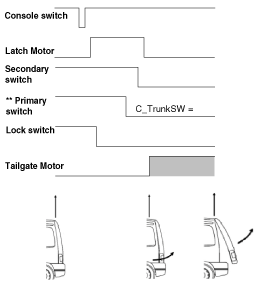
Power liftgate opening** - Primary switch signal received by the PTGM via CAN bus (sent by the IPM). PTGM opening procedure:
Opening can be initiated after receiving a signal from the console (driver) switch, the outside handle switch, or the remote key (FOB).
The latch will be unlocked (via the IPM) when the latch motor is actuated.
When the latch is opened, the liftgate latch is extended out of the striker.
The PTG module controls the liftgate motor to open the liftgate.
The liftgate opening angle is calculated by counting the input pulse signals from the Hall sensor.
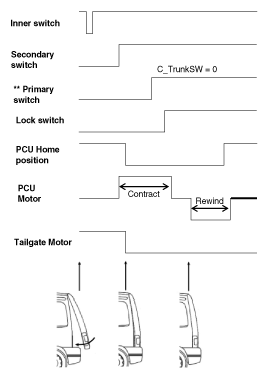
Closing can be initiated after receiving a signal from the console (driver) switch, the outside handle switch, the remote key (FOB), or the interior switch.
The PTG module controls the liftgate motor to close the liftgate.
The liftgate closing angle is calculated by counting the input pulse signals from the Hall sensor.
The liftgate latch engages with the striker and the latch locks mechanically (latch unlocked → latch locked).
The PTGM stops the liftgate motor operation after the liftgate secondary latch signal is detected.
When a secondary latch signal is detected, the power closing unit (PCU) starts the cinch operation and stops after the latch lock signal is detected.
After the cinch operation ends, the PCU rewinds until the PCU home position is reached.
The liftgate is fully closed and the latch is fully locked.
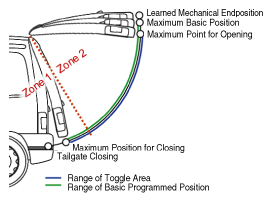
Maximum Opening Point: Starting an opening operation above this position may cause the liftgate to move beyond the maximum base position and overload the mechanical system (hinges). Therefore, starting the opening operation above this point is disabled. In any case, if the operation was started at a lower position, the liftgate will move beyond this point.
Learned Mechanical End Position: This is the mechanical stop position when opening and is considered to be 100% open. When the liftgate is opened for the first time, this position is learned. After learning, the liftgate will not move beyond the maximum base position, which is determined by the learned mechanical position minus a safety distance. All positions are determined by parameters in the ECU or programmed by the user (programmed base position).
The adjustable programmed base position is set equal to the maximum base position after the learned mechanical end position has been learned.
A.
The customer can change the programmed base position to any new position between the maximum closing point and the maximum base position.
B.
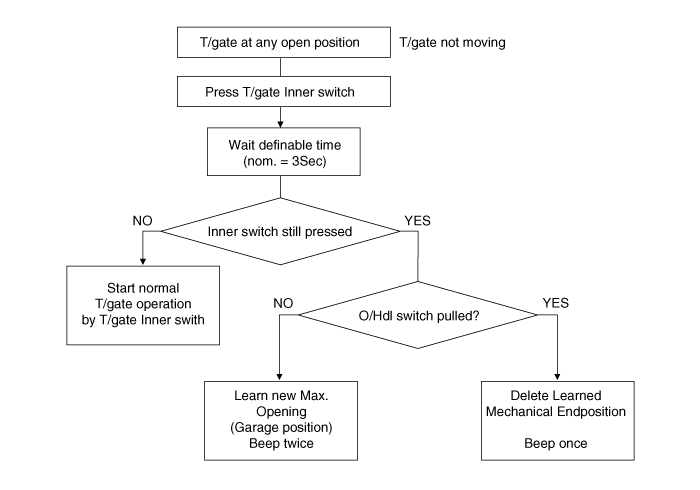
If the customer wants to set a new programmed base position lower than the current programmed base position, move the liftgate electrically or manually to the new position and press the interior switch for approx. 3 seconds (time can be changed by parameter).
C.
If the customer wants to set a new programmed base position higher than the current programmed base position, move the liftgate manually to the new position and press the interior switch for 5 seconds (time can be changed by parameter).
D.
If the user attempts to program a liftgate position above the maximum base position, the ECU will set the programmed base position to the maximum base position.
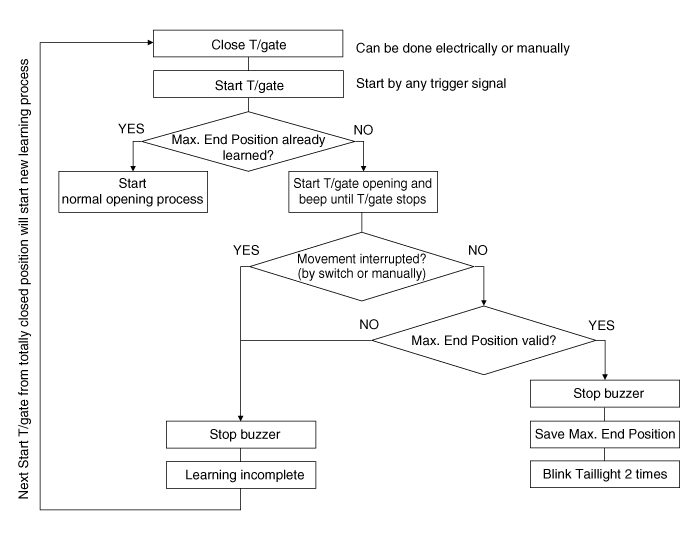
Power liftgate closing. PTGM closing procedure: Learned/Calculated/Programmed Positions. Programming Max. Liftgate Open (Garage Position). System Parameterization: Due to mechanical tolerances and adjustments in vehicle production and assembly, the power liftgate requires calibration of the maximum travel range before proper operation can be ensured. The maximum travel range of the liftgate is represented by the number of Hall pulses received by the ECU from the drive unit speed/position sensors while the liftgate moves from the fully closed position (fully latched position) to the upper end position, limited by the mechanical stops (e.g., upper bump stops, spindle length, etc.). Calibration Mode. Manual Decalibration Mode. System Initialization: System initialization is required to determine that the liftgate is closed (position 0). After a reset when the battery is connected, the initialization process must be performed to find the fully open and fully closed liftgate positions. After successful initialization, the closed liftgate position and the fully open liftgate position are learned, and normal opening and closing of the power liftgate can be ensured. Procedure: Refer to "Calibration Mode". The buzzer operation is described in the following table.
BUZZER
LAMP *)
NOTE
T/Gate start
2 times
2 times
When the liftgate is started by the remote key or the liftgate console switch.
T/Gate start
N/A
N/A
When the liftgate is started by the interior liftgate switch or the exterior liftgate manual switch.
T/Gate stop
N/A
N/A
System error
3 times
-
PCU/liftgate lock is active. Conditions: over/under voltage, end position/position error, spindle error, CAN error, latch closed when liftgate is open.
T/Gate not closed
10 times
10 times
Latch switch missing
During calibration
Continuous chime ON-OFF
N/A
Activate buzzer, but not C_PTHazard
Max. end position learned
N/A
2 times
Buzzer confirms learning is complete
Max. end position deleted
1 time
N/A
The buzzer confirms that the "position is cleared".
Vehicle moving with liftgate open
10 times
N/A
T/Gate open AND speed >3 km/h
Garage position stored
2 times
N/A
Buzzer confirms "New garage position"
*) The lamp will be synchronized by sending C_PTHazard to the buzzer at the same time as the signal.
?
Test yourself
A quick Kia Sorento Owner's Manual quiz: every answer comes with an explanation and a link to the manual page.