Seat belt precautions
Seat belts reduce the risk of serious injury in an accident or sudden stop. Mazda recommends that the driver and all passengers wear their seat belts at all times.
All retractors are designed to keep the lap/shoulder belts out of the way when they are not in use.
The driver's seat belt is not designed as a child restraint system; it has only an emergency locking mode. The driver can wear it comfortably, and it will lock during a collision.
However, on certain models (with the automatic locking mode), the front passenger seat and all rear lap/shoulder belt retractors operate in two modes: emergency locking mode and, for child restraint systems, automatic locking mode. Although it is recommended that all children be seated in the rear seats, if a child must be seated in the front passenger seat, move the front passenger seat as far back as possible and make sure the child restraint system is installed correctly.
WARNING
Always make sure you are wearing your seat belt and that all passengers are properly secured:
Not wearing a seat belt is extremely dangerous. In a collision, any passenger not wearing a seat belt may be thrown against another passenger or objects inside the vehicle, or may even be ejected from the vehicle. This could result in serious injury or death. In a collision, any passenger wearing a seat belt is at lower risk.
Do not wear twisted seat belts:
Twisted seat belts are dangerous. In a collision, the full width of the belt is not available to absorb the impact. This applies increased force to the bones beneath the belt, which can cause serious injury or death. If your seat belt is twisted, flatten it to remove the twist so that the full width of the belt is used.
Never use one seat belt to restrain more than one person at a time:
Using one seat belt to restrain more than one person at a time is dangerous. A seat belt used this way cannot distribute impact forces correctly, and both occupants may be crushed against each other and seriously injured or killed. Never use one seat belt for more than one person at a time, and always make sure each occupant has fastened their own seat belt.
Do not drive a vehicle with a damaged seat belt:
Using a damaged seat belt is dangerous. An accident may damage the webbing of any seat belt in use. A damaged seat belt cannot provide adequate protection in a collision. Have all seat belt systems used in an accident inspected by an authorized Mazda dealer before using them again.
Have the seat belts replaced immediately if the pretensioner or load limiter has deployed:
Always have an authorized Mazda dealer inspect the front seat belt pretensioners and the airbags immediately after a collision. Like airbags, front seat belt pretensioners and load limiters work only once and must be replaced after a collision in which they have deployed. A seat belt with a deployed pretensioner or load limiter still offers better protection than no seat belt at all. However, if the front seat belt pretensioners and load limiters are not replaced, the risk of injury in a collision will increase.
Position of the shoulder belt portion of the seat belt:
Incorrect positioning of the shoulder belt portion of the seat belt is dangerous. Always make sure the shoulder belt portion is worn over the shoulder and close to the neck, but never under the arm, behind the back, or on the arm.
Position of the lap belt portion of the seat belt:
Wearing the lap belt portion of the seat belt too high is dangerous. In a collision, it concentrates the impact force directly on the abdomen, which can cause serious injury. Wear the lap belt portion snug and as low as possible.
WARNING
Seat belt retraction may be difficult if the webbing and anchors are dirty, so keep them clean. For details on cleaning the seat belts, refer to “Cleaning the Lap/Shoulder Belts”.
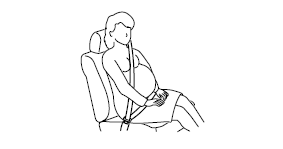
Pregnant women and persons with serious medical conditions
Pregnant women should always wear their seat belt. Ask your doctor for any specific recommendations.
The lap belt must be worn SNUG AND AS LOW AS POSSIBLE ON THE HIPS.
The shoulder belt must be worn correctly across the shoulder, but never over the abdomen.
Persons with serious medical conditions should also wear seat belts. Ask your doctor for any special instructions regarding your specific medical condition.
Emergency locking mode
When the belt is fastened, it will always be in emergency locking mode.
In emergency locking mode, the belt stays at a comfortable tension for the occupant, and the retractor will lock in a collision.
If the belt is buckled and cannot be pulled out, retract the belt, then pull it out gently. If this fails, pull the belt firmly, release it, then pull it out gently.
(Seat belt with automatic locking mode)
When the belt is fastened, it will always be in emergency locking mode until it is switched to automatic locking mode by pulling it out fully. If the belt is too tight and restricts movement while the vehicle is stopped or moving, it may be in automatic locking mode because it has been pulled out too far.
To return it to emergency locking mode, which is more comfortable, stop the vehicle in a safe, level place, retract the belt completely to return it to emergency locking mode, then fasten it again.
Automatic locking mode
Always use automatic locking mode to prevent the child restraint system from moving and ending up in a dangerous position in an accident. To set the seat belt to automatic locking mode, pull it out fully and install it as instructed in the child restraint system instructions.
It will retract onto the child restraint system and remain locked. Refer to the section on child restraint systems.
Test yourself
A quick Mazda 6 quiz: every answer comes with an explanation and a link to the manual page.