Exterior care
Car wash
WARNINGAfter driving through a car wash, braking efficiency is reduced. This could cause an accident. Therefore, drive with extreme caution until the brakes are dry.
WARNINGWhen HOLD or DISTRONIC PLUS is activated, the vehicle is braked. Therefore, deactivate HOLD or DISTRONIC PLUS before driving the vehicle through a car wash.
If you drive the vehicle through a car wash with a conveyor drive, make sure the selector lever of the automatic transmission is in position N. If the transmission is in any other position, the vehicle may be damaged.The vehicle can be driven into an automatic car wash without any preparation.
If the vehicle is heavily soiled, prewash it before driving it through the car wash.
After driving through the car wash, remove the wax deposits from the windshield and the wiper blade rubber.
This prevents streaks from forming and reduces noise that may occur when the wiper blades pass over deposits.
Hand washing
In some countries, hand washing is only permitted at specially designated washing areas.
Observe the legal regulations applicable in the respective countries.
- Do not use hot water and do not wash the vehicle in direct sunlight.
- For cleaning, use a soft sponge designed for vehicle washing.
- Use a mild cleaning agent (for example, a car shampoo approved by Mercedes-Benz).
- Rinse the vehicle thoroughly with a moderate-pressure water jet.
- Do not direct the water jet directly at the air intake grilles.
- Use plenty of water and rinse the sponge frequently.
- Rinse the vehicle with clean water, then dry it thoroughly with a chamois leather.
- Do not let the cleaning agent dry on the paint.
When driving the vehicle in winter, remove road salt deposits thoroughly and as soon as possible.
High-pressure cleaner
WARNINGDo not use a high-pressure cleaner equipped with a rotating nozzle (rotary brush) to clean your vehicle, especially the tires. Otherwise, you could damage the tires and cause an accident.
Maintain a distance of at least 30 cm / 12 in between the vehicle and the high-pressure cleaner nozzle. For information on the correct distance, contact the manufacturer of the equipment.
Keep the nozzle moving continuously during cleaning.
Do not direct the jet directly at
- the tires
- door gaps or the roof area, seals, etc.
- electrical components
- the battery
- connections
- the bulbs
- the seals
- the decorative inserts
- the ventilation slots
Damaged seals or electrical components can cause leaks or malfunctions.
Cleaning the wheels
Do not use acidic wheel cleaner to remove brake dust from the brake pads. Otherwise, the wheel bolts and brake components could be damaged. Do not park the vehicle for an extended period immediately after cleaning, especially if the wheels have been treated with a wheel cleaner. Such products can accelerate corrosion of the brake discs and brake pads. Therefore, drive for a few minutes after cleaning. When braking, the brake discs and brake pads heat up and dry out. You may then park the vehicle for an extended period.Cleaning the paint
On painted surfaces, never apply- stickers
- films
- magnetic signs or similar
Otherwise, you could damage the paint.
- Remove soiling immediately if possible, avoiding excessive rubbing.
- Apply insect remover to insect traces, let it act, then rinse the treated surfaces.
- Moisten bird droppings, let them act, then rinse the treated surfaces.
- Remove traces of coolant, brake fluid, tree resin, oil, fuel and grease with a cloth soaked in cleaning petrol or lighter fuel, rubbing lightly.
- Remove tar spots with a tar remover.
- Remove wax with a silicone remover.
It is not always possible to completely remove
- scratches
- aggressive deposits
- acid attack
- damage resulting from incorrect maintenance
In this case, contact a qualified workshop.
Care and treatment of matte paint
Never polish the vehicle or the alloy wheels. Polishing makes the paint glossy. The following can make the paint glossy and reduce the matte effect:- Intensive rubbing with inappropriate products
- Frequent visits to car washes
- Washing the vehicle in direct sunlight
Always have paint touch-ups carried out by a qualified workshop.
Never select a wash program with a hot wax final treatment.If your vehicle has a matte clear coat, observe these notes. This will help you avoid damaging the paint through improper treatment.
These notes also apply to alloy wheels with a matte clear coat.
Preferably clean your vehicle by hand, using a soft sponge, car shampoo and plenty of water. Of the care products recommended and approved by Mercedes-Benz, use only the insect remover and car shampoo.Cleaning the windows
WARNINGSwitch off the wipers and remove the key from the ignition switch before cleaning the windshield or wiper blades. Otherwise, the wipers may start moving and you could be injured.
To avoid damaging the hood, position the wiper arms vertically before folding them forward. To clean the inside of the windows, do not use dry cloths, abrasive products, solvents or cleaning products containing solvents. Do not touch the inside of the windows with hard objects such as an ice scraper or a ring. Otherwise, the windows may be damaged. Regularly clean the drainage channels of the windshield and rear window. Natural deposits (leaves, flowers, pollen, etc.) may prevent water from draining away. This can lead to corrosion damage and damage to the electronic components.- Clean the inside and outside surfaces of the windows with a damp cloth and a cleaning agent approved and recommended by Mercedes-Benz.
Cleaning the wiper blades
WARNINGSwitch off the wipers and remove the key from the ignition switch before cleaning the windshield or wiper blades. Otherwise, the wipers may start moving and you could be injured.
To avoid damaging the hood, position the wiper arms vertically before folding them forward. Do not pull on the wiper blade. Otherwise, you could damage the wiper blade. Do not clean the wiper blades too often and avoid rubbing them too hard. Otherwise, you risk damaging the graphite coating. The wipers could then produce noise when wiping.- Move the wiper arms away from the windshield.
- Carefully clean the wiper blades with a damp cloth.
- Fold the wiper arms back onto the windshield before switching on the ignition.
Cleaning the exterior lighting
Only use cleaning products or cleaning cloths that are compatible with plastic diffusers.Using unsuitable cleaning products or cloths may scratch or damage the plastic lenses of the exterior lighting.
- Clean the plastic lenses of the exterior lighting with a damp sponge and a mild cleaning product (e.g. Mercedes-Benz car shampoo) or with cleaning cloths.
Cleaning the turn signal indicators integrated in the mirrors
Only use cleaning products or cleaning cloths that are compatible with plastic diffusers.Using unsuitable cleaning products or cloths may scratch or damage the plastic lenses of the turn signal indicators integrated in the mirrors.
- Clean the plastic lenses of the turn signal indicators integrated in the exterior mirror housings with a damp sponge and a mild cleaning product (e.g. Mercedes-Benz car shampoo) or with cleaning cloths.
Cleaning the sensors
If you clean the sensors with a high-pressure cleaner, observe the distance to be maintained between the vehicle and the high-pressure cleaner nozzle (at least 30 cm / 12 in). For information on the correct distance, contact the manufacturer of the equipment.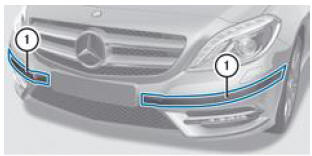

- Clean the sensors 1 of the driver assistance systems with water, shampoo and a soft cloth.
Cleaning the reversing camera
Do not clean the reversing camera lens and the area around the reversing camera with a high-pressure cleaner.
- Clean the camera lens 1 with clear water and a soft cloth.
Cleaning the exhaust tailpipes
Do not clean the exhaust outlets with an alkaline cleaner, such as a wheel cleaner.- Clean the exhaust tailpipes with a chrome care product tested and approved by Mercedes-Benz.
Under the effect of road salt and environmental conditions, deposits can form a thin layer of rust on the surface. Regular care, especially in winter and after every vehicle wash, can restore the original shine of the exhaust tailpipes.
Cleaning the towing hitch
Environmental protectionDispose of rags soaked in oil and grease in accordance with environmental protection regulations.
Do not clean the ball joint with a high-pressure cleaner. Do not use solvents.Also observe the maintenance instructions of the trailer manufacturer.
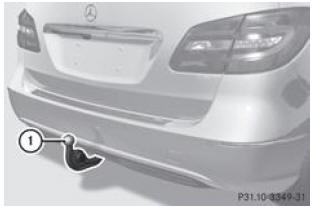
- Remove rust, for example with a wire brush.
- Remove dirt with a clean, lint-free cloth or with a brush.
- After cleaning, apply a light coat of oil or grease to the ball joint 1.
- Check the operation of the towing hitch on the vehicle.
Test yourself
A quick Mercedes-Benz B-Class quiz: every answer comes with an explanation and a link to the manual page.