Fitting wheels
Vehicle preparation
- Park the vehicle on a firm, level, non-slip surface.
- Apply the electric parking brake manually.
- Position the front wheels straight ahead.
- Vehicles with manual transmission: engage 1st gear or reverse gear.
- Vehicles with automatic transmission: move the DIRECT SELECT selector lever to P.
- Switch off the engine.
- Remove the key from the ignition switch.
- If a trailer is attached, uncouple it.
- Remove the wheel change tools from the vehicle, if your equipment includes them.
- Secure the vehicle so that it cannot roll away.
The tools required for a wheel change may include the following:
- Jack
- Wheel chock
- Wheel wrench
Securing the vehicle
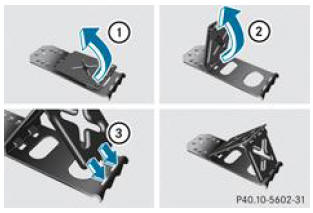
If your vehicle is equipped with a wheel chock, you will find it in the on-board tool kit.
The folding wheel chock is an additional means of securing the vehicle and preventing it from rolling (when changing a wheel, for example).
- Lift up the 2 plates 1.
- Unfold the lower plate outwards 2.
- Fully engage the lugs of the lower plate in the holes of the base plate 3.

Securing the vehicle on level ground
- On a level road: place a wheel chock or other suitable object under the wheel diagonally opposite the wheel to be replaced.
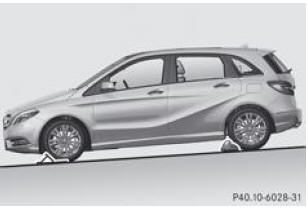
Securing the vehicle on a gentle slope
- On a sloping road: place a wheel chock or other suitable object under each of the front and rear wheels.
Lifting the vehicle
WARNINGIf the jack is not positioned correctly under the designated jacking point on the vehicle, the jack may slip when the vehicle is raised. There is a risk of injury.
Position the jack only under the designated jacking point on the vehicle. The jack base must be located directly below the jacking point of the vehicle.
Observe the following notes when raising the vehicle:
- To raise the vehicle, use only the jack tested and approved by Mercedes-Benz for your vehicle. If the jack is used improperly, it may slip when the vehicle is raised.
- The jack is only intended to raise the vehicle for a limited time during a wheel change. The jack is not designed for carrying out maintenance work under the vehicle.
- Avoid changing a wheel when the vehicle is on a slope (uphill or downhill).
- Before raising the vehicle, secure it with the parking brake and wheel chocks to prevent it from rolling. Never release the parking brake while the vehicle is raised.
- The jack must rest on a flat, firm and non-slip surface. On soft ground, place a wide support capable of bearing the load under the jack. On slippery ground, use an anti-slip protection (a rubber mat on tiles, for example).
- Do not place a block of wood or similar object as a base under the jack. Otherwise, due to the limited height, the jack would not be able to extend sufficiently to reach its normal load capacity.
- Make sure that the lower edge of the tire is no more than 3 cm above the ground.
Never put your hands or feet under the vehicle while it is raised.
- Never slide under the vehicle while it is raised.
- Never start the engine while the vehicle is raised.
- Never open or close any door or the tailgate while the vehicle is raised.
- Make sure that no one is inside the vehicle while it is raised.
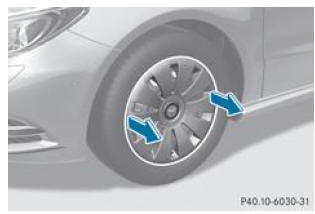
Steel wheel with wheel cover
- Vehicles fitted with steel wheels: grasp the wheel cover at 2 of the openings and carefully remove it

- Using the wheel wrench 1, loosen the wheel bolts of the wheel to be changed by approximately 1 turn. Do not remove them completely.
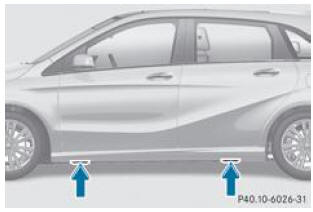
The jacking points are located behind the wheel arches at the front and in front of the wheel arches at the rear (arrows).
- Take the ratchet socket wrench from the wheel change tool kit and fit it onto the hex nut of the jack so that the marking AUF is visible.
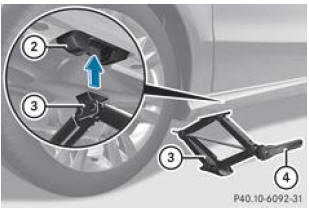
- Position the jack 3 under the jacking point 2.
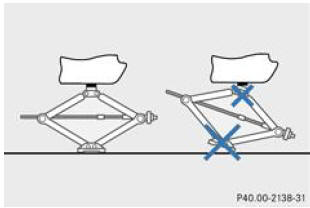
- Make sure that the base of the jack is located directly below the jacking point.
- Turn the ratchet socket wrench 4 until the jack 3 is fully seated under the jacking point 2 and the jack's base rests completely on the ground.
- Continue turning the ratchet socket wrench 4 until the tire is no more than 3 cm above the ground.
Removing the wheel
Do not place the wheel bolts in sand or dirt. Otherwise, the threads of the wheel bolts and the internal threads of the wheel hubs could be damaged when tightening.- Remove the wheel bolts.
- Remove the wheel.
Fitting a new wheel
WARNINGIf the wheel bolts are oiled or greased and the wheel bolts or the threads of the wheel hub are damaged, the wheel bolts may loosen. You may then lose a wheel while driving. There is a risk of accident.
Never oil or grease the wheel bolts. If the threads are damaged, contact a qualified workshop immediately. Have damaged wheel bolts or a damaged wheel hub thread replaced. Do not continue driving.
WARNINGIf you tighten the wheel bolts or nuts while the vehicle is raised, the jack may slip. There is a risk of injury.
Tighten the wheel bolts or nuts only when the vehicle is lowered.
Be sure to observe the instructions and safety notes on "Changing a wheel".
Use only wheel bolts intended for the wheel type fitted and for your vehicle. For safety reasons, Mercedes-Benz recommends using only wheel bolts approved for Mercedes-Benz vehicles and for the wheel type fitted.

- Clean the contact surfaces between the wheel and the hub.
- Slide the new wheel onto the wheel hub and press it against the hub.
- Fit the wheel bolts and tighten them lightly.
Lowering the vehicle
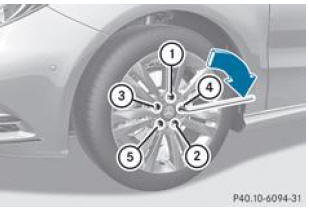
- Fit the ratchet socket wrench onto the hex of the jack so that the marking AB is visible.
- Turn the ratchet socket wrench until the vehicle rests on the ground again.
- Set the jack aside.
If you do not tighten the wheel bolts or nuts to the specified tightening torque, the wheels may come loose. There is a risk of accident.
After changing a wheel, have the tightening torque checked immediately by a qualified workshop.
- Tighten the wheel bolts evenly in the order indicated 1 to 5, i.e. crosswise. The tightening torque must be 130 N·m .
- Return the jack to its initial position.
- Stow the jack and the rest of the wheel-change tools in the vehicle.
- Check the tire pressure of the newly fitted wheel and correct it if necessary.
Then observe the recommended inflation pressure.
Test yourself
A quick Mercedes-Benz B-Class quiz: every answer comes with an explanation and a link to the manual page.