Notes on tire pressure
Tires with pressure that is too low or too high present the following risks:
- They may burst, especially when the load or vehicle speed increases.
- They may wear excessively and/or unevenly, which can significantly reduce their grip.
- The vehicle's handling, steering and braking behavior may be severely impaired.
There is a risk of an accident.
Observe the recommended tire pressures and check the pressure of each tire, including the spare wheel,
- at least every 2 weeks
- if the load has been changed
- before long trips
- if the operating conditions have changed (driving off-road, for example)
Correct the tire pressure if necessary.
WARNINGIf you fit an unsuitable accessory to the tire valves, this can cause overloading and valve failure, which results in loss of tire pressure. Tire pressure monitoring systems offered as aftermarket equipment keep the valves open due to their design. This can also cause tire pressure loss. There is a risk of an accident.
Screw only the valve caps supplied as standard or other valve caps specifically approved by Mercedes-Benz for your vehicle onto the tire valves.
WARNINGIf tire pressure drops repeatedly, the wheels, valves or tires may be damaged. Tire pressure that is too low can cause a tire to burst. There is a risk of an accident.
Check for foreign objects.
Check the wheel and valve for leaks.
If you cannot remedy the damage, contact a qualified workshop.
Environmental protectionCheck the tire pressure regularly, at least every 15 days.
The fuel filler flap contains a table of recommended tire pressures for different operating conditions of the vehicle.
When towing a trailer: refer to the maximum value specified for the rear axle in the tire pressure table located in the fuel filler flap.
The tire pressure table in the fuel filler flap may list pressure values for different load conditions. These are shown in the table by a different number of occupants and amounts of luggage. The actual number of seats may differ. For more information, refer to the vehicle documents.
If no tire dimensions are indicated, the tire pressures given in the tire pressure table apply to all tires approved for this vehicle and fitted at the factory.
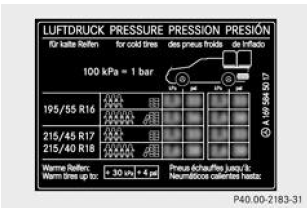
If the tire pressure is preceded by a tire size, the specified pressure applies only to these tire sizes.
Use a suitable tire pressure gauge to check the tire pressure. The outward appearance of a tire does not allow any conclusions about its pressure.
If possible, correct the pressure only when the tires are cold.
Tires are cold when
- the vehicle has been parked for 3 hours without the tires being exposed to sunlight
- you have driven less than 1.6 km (1 mile)
The temperature of the tires and therefore their pressure increase by approx. 10 kPa (0.1 bar, 1.5 psi) for every 10 °C , depending on ambient temperature, speed and tyre load. Take this into account when checking the pressure of warm tyres. Correct the tyre pressure only if it is too low for the current operating conditions.
Tire pressure that is too low or too high
- reduces tire service life
- increases the risk of tire damage
- impairs handling and therefore safety (aquaplaning, for example)
Pressures for a higher load are also suitable. They ensure good handling of the vehicle.
Test yourself
A quick Mercedes-Benz B-Class quiz: every answer comes with an explanation and a link to the manual page.