Starting and driving
Active Blind Spot Assist [ABSA]
In this manual: Starting and driving
5steps
~30min
2/5difficulty
Done 0 of 5
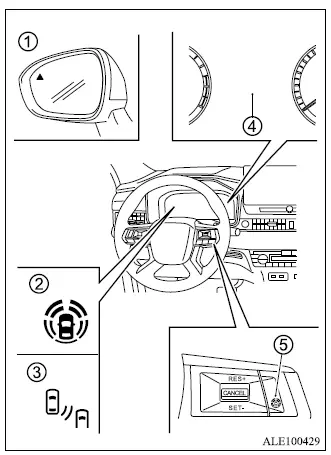
- Side indicator light
- ABSA ON indicator (on the multi-information display)
- ABSA indicator (on the multi-information display)
- Multi-information display
- MI-PILOT Assist switch
- The ABSA system uses radar sensors installed near the rear bumper to detect vehicles in adjacent lanes. It also uses a camera mounted behind the windshield to monitor the lane markings of the current travel lane.
- The ABSA system operates at speeds above approximately 60 km/h. If another vehicle is detected in the adjacent lane and the Mitsubishi Outlander approaches the lane marking on that side, a warning buzzer sounds, ABSA indicator 3 in multi-information display 4 flashes, and side indicator light 1 in the corresponding door mirror flashes. At the same time, the system can apply steering control to help guide the vehicle back toward the center of the travel lane.
A lane marker is a line positioned along the right or left side of a travel lane and used by the system to identify the lane boundaries.
NOTE
- If the Mitsubishi Outlander approaches a lane marker while the side indicator light is already illuminated, the audible warning and steering assistance can both activate. However, ABSA will not operate if another vehicle enters the radar detection zone only after your vehicle has already crossed the lane marker.
- The ABSA system generally activates earlier than the Lane Departure Prevention [LDP] system.
- The operating status of ABSA can be checked on the "Driver assistance" screen in the multi-information display.
Detection zone
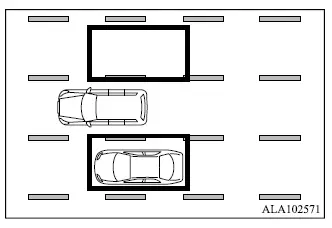
The radar sensors monitor detection zones on both the left and right sides of the vehicle to identify other vehicles traveling within the adjacent-lane areas.
Was this page helpful?