Rearview camera system operation
With the ignition switch in the ON position, move the shift lever to R (Reverse) to activate the Rearview camera system.
The camera image of the area behind the vehicle will appear on the Smartphone-link Display Audio [SDA] screen.
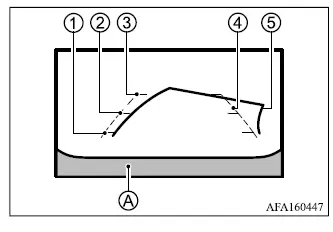
How to read the displayed lines
The monitor displays guide lines that indicate the approximate vehicle width and distances behind the Mitsubishi Outlander, using bumper line A as the reference point.
Distance guide lines:
These lines indicate approximate distances from the vehicle body.
- Red line 1: approximately 1.5 ft (0.5 m)
- Yellow line 2: approximately 3 ft (1 m)
- Green line 3: approximately 7 ft (2 m)
Vehicle width guide lines 4:
These guide lines indicate the approximate width of the vehicle while reversing.
Predictive course lines 5:
The predictive course lines indicate the approximate path the vehicle is expected to follow while backing up. They appear on the monitor when the shift lever is in R (Reverse) and the steering wheel is turned. The lines change according to the steering angle and are not displayed when the steering wheel is held in the straight-ahead position.
The displayed vehicle width guide lines and predictive course lines are wider than the actual vehicle width and path, and should therefore be treated as reference guides rather than exact boundaries.
Difference between predictive and actual distances
The guide lines shown on the display and their apparent positions on the ground are approximate references only. When the Mitsubishi Outlander is on an uphill or downhill slope, or when an object projects outward above ground level, its actual position may differ considerably from what the guide lines suggest. If there is any uncertainty, turn and look directly behind the vehicle while reversing, or stop, park safely, and get out of the vehicle to confirm the position of nearby obstacles.
Backing up on a steep uphill
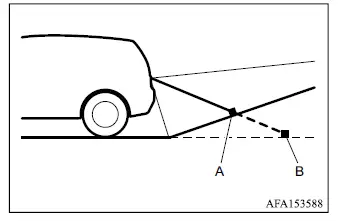
- Actual objects
- Objects shown on the screen
When the ground rises sharply behind the vehicle, objects displayed on the Rearview camera screen may appear farther away than they actually are.
Backing up on a steep downhill
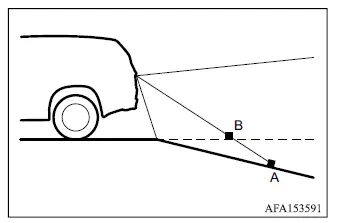
- Actual objects
- Objects shown on the screen
When the ground slopes downward behind the vehicle, objects shown on the monitor may appear closer than their actual distance from the Mitsubishi Outlander.
Weighed down by weigh
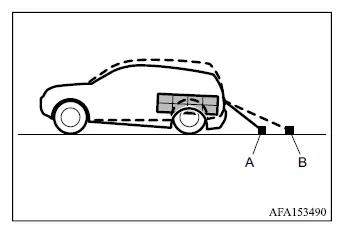
- Actual objects
- Objects shown on the screen
When the rear of the vehicle is lowered by the weight of passengers or luggage, objects visible on the screen may appear farther away than they actually are.
Backing up near a projecting object
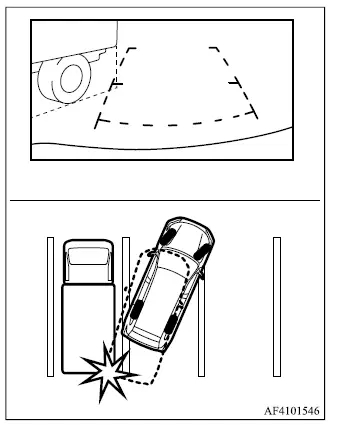
When reversing toward a projecting object such as a truck body, the reference lines may appear to show sufficient clearance even though the projecting portion of the object is actually within the vehicle's path. Always evaluate the complete shape of an obstacle rather than relying only on the guide lines.
Backing up behind a projecting object
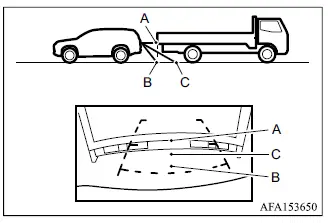
When an object behind the vehicle has an upper section that projects toward the Mitsubishi Outlander, the image on the monitor can create a misleading impression of distance. The guide lines may make point A appear farthest away and point B appear closest to the vehicle. In reality, points A and B are at approximately the same distance from the vehicle, while point C is farther away than both A and B.