Thermostat
Exploded View
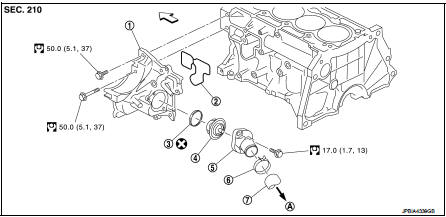
1. Thermostat housing 2. Gasket
3. Rubber ring
4. Thermostat
5. Water inlet
6. Clamp
7. Radiator hose (upper)
A. To radiator
 Engine front
 : N·m (kg-m, ft-lb)
 : Always replace after every
disassembly.
Removal and Installation
REMOVAL
1. Drain engine coolant from radiator. Refer to CO-11, "Draining".
CAUTION:Perform this step when engine is cold. 2. Remove intake manifold. Refer to EM-28, "Exploded View". 3. Disconnect radiator hose (lower) (RH) from water inlet. Refer to CO-17, "Exploded View".
4. Remove water inlet and thermostat.
• Engine coolant leakage from cylinder block, so have a receptacle ready below.
Thermostat housing1. Drain engine coolant. Refer to CO-11, "Draining". 2. Remove alterator. Refer to CHG-30, "MR16DDT : Exploded View". 3. Remove water pump. Refer to CO-22, "Exploded View".
4. Disconnect water hose, and them remove thermostat housing.
INSTALLATION
Note the following, and install in the reverse order of removal.
Thermostat
• Install thermostat with making rubber ring (1) groove fit to thermostat flange (A) with the whole circumference.

• Install thermostat (2) with jiggle valve (A) facing upwards.
1 : Thermostat housing
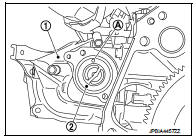
Thermostat housing
• Install in the reverse order of removal.
Inspection
INSPECTION AFTER REMOVAL
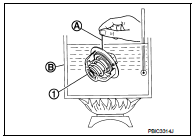
Thermostat• Place a thread (A) so that it is caught in the valves of thermostat (1). Immerse fully in a container (B) filled with water. Heat while stirring. • The valve opening temperature is the temperature at which the valve opens and falls from the thread. • Continue heating. Check the full open valve lift amount.
• After checking the maximum valve lift amount, lower the water temperature and check the valve closing temperature.
Standard: Refer to CO-29, "Thermostat".
• If out of the standard, replace thermostat.
INSPECTION AFTER INSTALLATION
• Check for leakage of engine coolant using the radiator cap tester adapter (commercial service tool) and the radiator cap tester (commercial service tool). Refer to CO-11, "Inspection".• Start and warm up the engine. Check visually that there is no leakage of engine coolant.