Speedometer Malfunction
DESCRIPTION
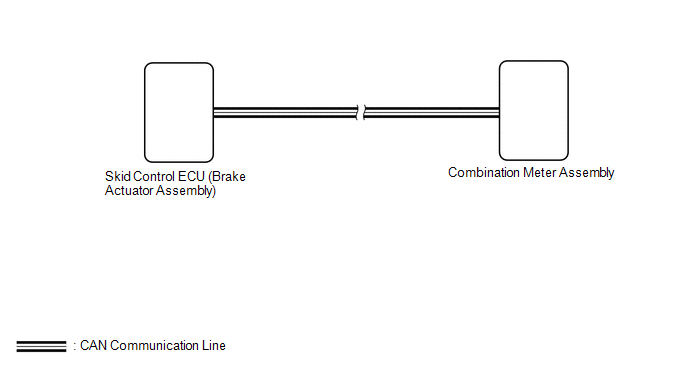
The combination meter assembly receives vehicle speed signals from the skid control ECU (brake actuator assembly) via CAN communication. The speed sensor detects the wheel speed and sends the appropriate signals to the skid control ECU (brake actuator assembly). The skid control ECU (brake actuator assembly) supplies power to the vehicle speed sensor. The skid control ECU (brake actuator assembly) detects vehicle speed signals based on pulses of the voltage.
HINT:
Factors that affect the indicated vehicle speed include the tire size, tire inflation, and tire wear. The speed indicated on the speedometer has an allowable margin of error.
WIRING DIAGRAM
NOTICE:
- When replacing the combination meter assembly, always replace it with a new one. If a combination meter assembly which was installed to another vehicle is used, the information stored in it will not match the information from the vehicle and a DTC may be stored.
- Before starting the following inspection, inspect the speedometer and check that the tire size and air pressure are as specified.
Tire size and air pressure: Click here

Speedometer: Click here
- When replacing the combination meter assembly, update the ECU security key.
Click here
PROCEDURE
CHECK CAN COMMUNICATION SYSTEM
(a) Check if CAN communication DTCs are output.
- for HEV Model:
Click here
- for Gasoline Model:
Click here
Result | Proceed to |
|---|---|
DTCs are not output |
A |
DTCs are output |
B |
| B |  |
GO TO CAN COMMUNICATION SYSTEM for HEV Model: Click here for Gasoline Model: Click here |
|

CHECK FOR DTC (ELECTRONICALLY CONTROLLED BRAKE SYSTEM)
(a) Check if electronically controlled brake system DTCs are output.
(1) for HEV Model
Chassis > Brake/EPB > Trouble Codes Chassis > Brake Booster > Trouble Codes(2) for Gasoline Model
Chassis > Brake/EPB > Trouble CodesResult | Proceed to |
|---|---|
DTCs are not output |
A |
DTCs are output |
B |
| B | |
GO TO ELECTRONICALLY CONTROLLED BRAKE SYSTEM for HEV Model: Click here for Gasoline Model: Click here |
|
PERFORM ACTIVE TEST USING GTS
(a) Perform the Active Test according to the display on the GTS.
Body Electrical > Combination Meter > Active TestTester Display | Measurement Item | Control Range | Diagnostic Note |
|---|---|---|---|
Speed Signal Input (0) |
Vehicle speed test signal input* (0 km/h, 0 mph) |
ON |
When this Active Test is performed, an actual vehicle speed signal is sent via CAN communication to the combination meter assembly to operate the speedometer. The seat belt warning buzzer, etc. may operate when performing this Active Test. |
Speed Signal Input (40) |
Vehicle speed test signal input* (40 km/h, 40 mph) |
ON |
|
Speed Signal Input (80) |
Vehicle speed test signal input* (80 km/h, 80 mph) |
ON |
|
Speed Signal Input (120) |
Vehicle speed test signal input* (120 km/h, 120 mph) |
ON |
|
Speed Signal Input (160) |
Vehicle speed test signal input* (160 km/h, 160 mph) |
ON |
|
Speed Signal Input (200) |
Vehicle speed test signal input* (200 km/h, 200 mph) |
ON |
|
Speed Signal Input (240) |
Vehicle speed test signal input* (240 km/h, 240 mph) |
ON |
When this Active Test is performed, an actual vehicle speed signal is sent via CAN communication to the combination meter assembly to operate the speedometer. The seat belt warning buzzer, etc. may operate when performing this Active Test. |
- *: For the tolerance of each Speed Signal Input Active Test, refer to On-vehicle Inspection.
Click here
Speed Signal Input (0)
Body Electrical > Combination Meter > Active TestSpeed Signal Input (40)
Body Electrical > Combination Meter > Active TestSpeed Signal Input (80)
Body Electrical > Combination Meter > Active TestSpeed Signal Input (120)
Body Electrical > Combination Meter > Active TestSpeed Signal Input (160)
Body Electrical > Combination Meter > Active TestSpeed Signal Input (200)
Body Electrical > Combination Meter > Active TestSpeed Signal Input (240)
OK:
Speedometer indication is normal.
| OK | |
REPLACE SKID CONTROL ECU (BRAKE ACTUATOR ASSEMBLY) |
| NG | |
REPLACE COMBINATION METER ASSEMBLY |