Guide for using trailers
Trailer socket
In this manual: Guide for using trailers
~1min read
| The trailer socket must be connected in accordance with the manufacturer's instructions to the electrical system of the pulling vehicle. When installing, observe the relevant current flow diagrams and the installation instructions from the manufacturer of the towing device. |
»7-pin« trailer socketIf more than the recommended number of electrical consumers is to be connected in a system with a »7-pin« socket, a second »7-pin« socket must be installed. Assignment of the pins should be carried out in accordance with DIN ISO 1724 as follows:1 - Left turn signal2 - Rear fog light3 - Earth4 - Right turn signal5 - Driving light, marker light, right number plate light6 - Brake light7 - Driving light, marker light, left number plate light |
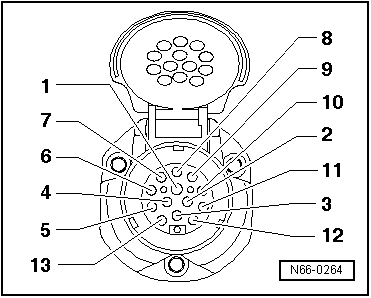
»13-pin« trailer socketReversing lights, »permanent current« and charge lead on the trailer can be used via the »13-pin« trailer socket. If a bike trailer or a caravan is to be towed, for example, it is recommended that a »13-pin« trailer socket is always used. |
Assignment of the pins should then be carried out in accordance with DIN ISO 11446 as follows: 1 - Left turn signal2 - Rear fog light3 - Earth for current circuit 1 to 84 - Right turn signal5 - Right driving light6 - Brake light7 - Left driving light8 - Reversing light9 - Terminal 30 (permanent positive)10 - Terminal 15 (charge battery in trailer)11 - Not assigned12 - Not assigned13 - Earth for terminal 15/30 |
 |
Test yourself
A quick Volkswagen Golf quiz: every answer comes with an explanation and a link to the manual page.
Was this page helpful?