Spare wheel or temporary spare wheel
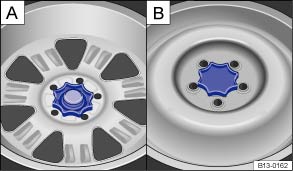
Fig. 148 In luggage compartment: variant A: handwheel for securing spare wheel and variant B: handwheel for securing temporary spare wheel
 First read and observe the introductory information and safety warnings
Removing the spare wheel
- Open the tailgate then lift up and secure the variable load surface as required .
- Hook the floor covering onto the top edge of the luggage compartment.
- Remove the toolbox .
- Completely unscrew the handwheel in the middle of the spare wheel A or the temporary spare wheel B anticlockwise and remove spare wheel or temporary spare wheel.
Storing the removed wheel
- Open the tailgate then lift up and secure the variable load surface as required.
- Hook the floor covering onto the top edge of the luggage compartment.
- Place the removed wheel into the spare wheel well with the rim facing downwards with the central hole in the rim positioned exactly above the stud.
- Turn the handwheel clockwise on the stud until the wheel is secured firmly.
- If necessary, place the vehicle toolkit back in the container in the luggage compartment.
- Unhook the floor covering and place it back on the luggage compartment floor.
- Close the tailgate.
If the spare wheel tyre is not the same as the tyres that are mounted on the vehicle
If the spare wheel is not the same as those mounted on the vehicle – for example if winter tyres or the temporary spare wheel are fitted – only use the spare wheel for a short period of time and drive with extra care .
Refit the normal, functional road wheel as soon as possible.
Follow these driving guidelines:
- Do not drive faster than 80 km/h.
- Avoid full acceleration, sudden braking and fast driving through bends in the road.
- Do not use snow chains on the temporary spare wheel .
- The tyre pressure must be checked as soon as possible after fitting the spare wheel or temporary spare wheel .
The tyre pressure of the spare wheel or temporary spare wheel should be checked together with the normal tyres, at least once a month. The spare wheel should have the highest pressure allowed for the vehicle . The tyre pressure for the temporary spare wheel can be found on the sticker on the temporary spare wheel.
 Incorrect use of the spare wheel or temporary spare wheel can lead to a loss of control of the vehicle, to collisions or other accidents and cause serious injuries.
- Never use a spare wheel or temporary spare wheel if it is damaged or worn down to the tread wear indicators.
- In some vehicles, the spare wheel could be smaller than the standard wheel. The small spare wheel has a sticker with the text 80 km/h or 50 mph. This is the maximum speed at which you are permitted to drive with this tyre.
- Never drive faster than 80 km/h. Do not accelerate quickly, brake suddenly or drive at high speed through bends.
- Never drive further than 200 km with a temporary spare wheel if it is fitted to the drive axle.
- The temporary spare wheel should be exchanged for a normal wheel as soon as possible. The temporary spare wheel is designed for a short period of use only.
- The temporary spare wheel must always be secured firmly with the wheel bolts supplied by the factory.
- Never use more than one temporary spare wheel at a time.
- After fitting the temporary spare wheel, the tyre pressure must be checked as soon as possible .
- Snow chains cannot be used on the temporary spare wheel.

If possible, stow the spare wheel, temporary spare wheel or the removed wheel safely in the luggage compartment. In vehicles with a breakdown set, the removed wheel cannot be secured.
Test yourself
A quick Volkswagen Polo quiz: every answer comes with an explanation and a link to the manual page.