Instrument panel, instruments, SVA
Instrument cluster insert
Assembly overview - Instrument cluster insert
Assembly overview - Instrument cluster insert, warning lamp symbols, petrol engine

Note
Depending on equipment, different instrument cluster inserts are used, so the arrangement of the indicator lamps may differ from the illustration.

- Left turn signal indicator lamp
- Switched on
- Electronic Stability Program (ESP) indicator lamp
- Flashes: Electronic Stability Program (ESP) is regulating
- Lights up: ESP faulty or switched off
- Anti-lock Braking System (ABS) indicator lamp
- Malfunction
- Airbag system / belt tensioner indicator lamp
- Airbag and/or belt tensioner faulty
- Seat belt indicator lamp
- Fasten seat belts!
- Tire pressure monitoring indicator lamp
- Tire pressure of one wheel is too low or a system fault is present
- High beam indicator lamp
- Switched on
- Rear fog light indicator lamp
- Switched on
- Electromechanical power steering (EPS - Electronic Power Steering) indicator lamp
- Lights up yellow: electromechanical power steering reduced
- Lights up red: electromechanical power steering failed
- Cruise control system (CCS) indicator lamp
- CCS is regulating
- "Press brake pedal" indicator lamp
- Request from automated manual transmission (SQ)
- Indicator lamp only fitted on vehicles with automated manual transmission
- Coolant temperature indicator lamp
- Coolant temperature too high or
- Engine coolant level too low
- Engine oil pressure indicator lamp
- Engine oil pressure too low
- Switch off engine and check engine oil level
- Right turn signal indicator lamp
- Switched on
- Fuel level indicator lamp
- Fuel level too low (reserve amount)
- CNG fuel level indicator lamp
- Indicator lamp only fitted on CNG vehicles
- Fuel level too low (reserve amount)
- Parking brake indicator lamp
- Parking brake applied
- Brake system indicator lamp
- Lights up: fault in the brake system
- Lights up: brake fluid low - switch off engine and check brake fluid
- Generator indicator lamp
- Fault in generator
- Engine malfunction EPC (electronic power control) indicator lamp
- Malfunction
- Electronic On-Board Diagnostics (EOBD) indicator lamp
- Fault in exhaust system
- Transmission fault indicator lamp, automated manual transmission (red)
- Indicator lamp only fitted on vehicles with automatic transmission
- Transmission fault indicator lamp, automated manual transmission (yellow)
- Indicator lamp only fitted on vehicles with automated manual transmission
Assembly overview - instrument cluster, indicator lamp symbols, CNG engine
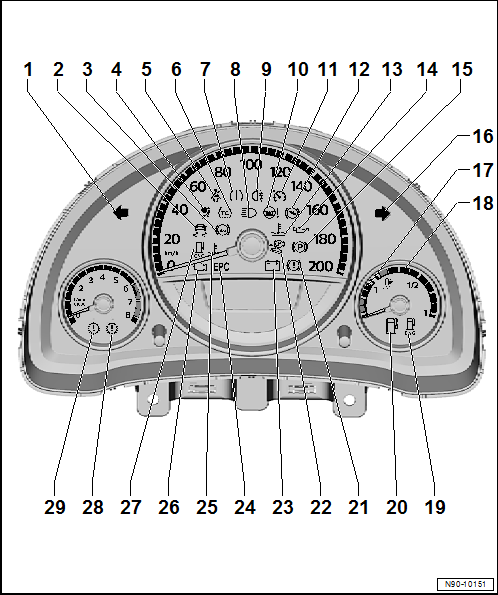
- Left turn signal indicator lamp
- Switched on
- Electronic Stability Program (ESP) indicator lamp
- Flashes: Electronic Stability Program (ESP) is regulating
- Lights up: ESP faulty or switched off
- Anti-lock Braking System (ABS) indicator lamp
- Malfunction
- Airbag system / belt tensioner indicator lamp
- Airbag and/or belt tensioner faulty
- Seat belt indicator lamp
- Fasten seat belts!
- Traction control indicator lamp
- Flashes: regulating
- Lights up: faulty or switched off due to system condition
- Tire pressure monitoring indicator lamp
- Tire pressure of one wheel is too low or a system fault is present
- High beam indicator lamp
- Switched on
- Rear fog light indicator lamp
- Switched on
- Electromechanical power steering (EPS - Electronic Power Steering) indicator lamp
- Lights up yellow: electromechanical power steering reduced
- Lights up red: electromechanical power steering failed
- Cruise control system (CCS) indicator lamp
- CCS is regulating
- "Press brake pedal" indicator lamp
- Indicator lamp only fitted on vehicles with automated manual transmission
- Request from automated manual transmission (SQ)
- Coolant temperature indicator lamp (red)
- Coolant temperature too high or
- Coolant level too low
- Engine oil pressure indicator lamp
- Engine oil pressure too low
- Switch off engine and check engine oil level
- Parking brake indicator lamp
- Parking brake applied
- Right turn signal indicator lamp
- Switched on
- Fuel level display, petrol
- Fuel level display, CNG
- CNG fuel level indicator lamp
- Fuel level too low (reserve amount)
- Fuel level indicator lamp, petrol
- Fuel level too low (reserve amount)
- Brake system indicator lamp
- Lights up: fault in the brake system
- Lights up: brake fluid low - switch off engine and check brake fluid
- Automated manual transmission indicator lamp
- Flashes: vehicle is not secured against rolling away
- Three-phase generator indicator lamp
- Fault in three-phase generator
- Engine malfunction EPC (electronic power control) indicator lamp
- Malfunction
- Coolant temperature indicator lamp (blue)
- Coolant temperature too low
- Electronic On-Board Diagnostics (EOBD) indicator lamp
- Fault in exhaust system
- Fuel level indicator lamp, CNG vehicle
- CNG fuel tank almost empty
- Transmission fault indicator lamp, automated manual transmission (red)
- Indicator lamp only fitted on vehicles with automated manual transmission
- Fault in automated manual transmission
- Transmission fault indicator lamp, automated manual transmission (yellow)
- Indicator lamp only fitted on vehicles with automated manual transmission
- Automated manual transmission overheated or gears cannot be engaged correctly
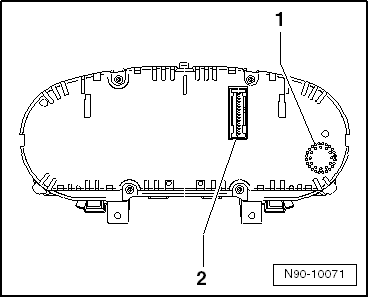
Assembly overview - instrument cluster, rear side

Note
Do not disassemble the instrument cluster. If necessary, replace the instrument cluster completely.
- Warning buzzer
- Plug connection

Note
Pin assignment of the plug connection on the instrument cluster: → Current flow diagrams, electrical fault finding and installation locations
Removing and installing instrument cluster -KX2-

Note
- All indicator lamps in instrument cluster -KX2- are fitted with LEDs. LEDs cannot be replaced individually if faulty. The instrument cluster must be replaced.
- Do not disassemble instrument cluster -KX2-.
- Removing instrument cluster -KX2- does not require removal of the steering wheel.
- After installing a new instrument cluster, all ignition keys must be adapted.
- If instrument cluster -KX2- is replaced with control module in instrument cluster -J285-, select the function Replace respective control module in the operating mode Guided fault finding or Guided functions → Vehicle diagnostic tester.
- Connect the vehicle diagnostic tester.
- Read current data (coding, service data, odometer reading) from the instrument cluster → Vehicle diagnostic tester.
Removing
- Switch off ignition and all electrical consumers and remove the ignition key.
- Lock the steering wheel in its lowest position.
- Remove the column trim cover from the instrument panel. → Body Assembly Work, Interior.
- Unscrew the mounting screws -arrows- of the instrument panel insert -1-.
- Pull the instrument panel insert -1- straight out of the instrument panel.

- Swing the locking clip -1- in the -direction of arrow- and disconnect the electrical connector -2-.
- Remove the instrument panel insert from the vehicle.
Installing
Installation is carried out in the reverse order of removal, observing the following:
Tightening torques