Guide to trailer towing
Foreword
This guide is divided into two parts.
The first part contains information and important notes on the subject of "trailer towing". For example, it describes the technical requirements for towing trailers and the function of the trailer control module.
The second part contains tables listing the towing capacities (braked, unbraked and nose weight) of the vehicles (sorted by engine output) and, where possible, the requirements that must be met to increase the towing capacity of a vehicle.
Volkswagen vehicles are designed according to the latest findings in safety engineering.
It is therefore recommended that only parts marked as genuine Volkswagen parts are used. These parts have been verified for reliability, safety and suitability.
For other products, this cannot be assessed despite ongoing market monitoring, even if in individual cases a TÜV inspection (e.g. sample expert report) or an official approval exists. Liability therefore cannot be accepted for fitting these products.
Legal regulations outside Germany
Observe the country-specific laws and directives. For questions, contact your importer.
Technical requirements
Towing device fitted at the factory
If the vehicle was already supplied with a towing device from the factory, everything technically and legally required for trailer towing has already been taken into account.
Note that since early 1988, many models have a "13-pin" socket for trailer operation instead of the conventional "7-pin" socket. This new socket allows additional electrical consumers on the trailer to be connected later, for which there were no connection options on the previous socket, e.g. for a reversing light.
If the trailer to be towed has a "7-pin" plug, an adapter cable available from Volkswagen dealers can be used.
Towing device fitted later
If the vehicle is to be retrofitted with a towing device, note the following:
The towing device is a safety component. Therefore, only a type-approved device developed for the vehicle in question may be used. It is recommended to use towing devices from the Volkswagen accessories range, as they are identical to the factory-fitted devices. For these devices, the supplied installation instructions are also coordinated with Volkswagen.
Towball
Height:
350 to 420 mm, measured from centre of towball to road surface at permissible gross weight
Distance:
Minimum 65 mm, measured from centre of towball to bumper
Trailer socket
Connect the trailer socket to the tow vehicle's electrical system according to the manufacturer's instructions.
When installing, observe the relevant circuit diagrams or the installation instructions from the towing device manufacturer.
"7-pin" trailer socket
If more electrical consumers than those intended for the trailer operation are to be connected to a "7-pin" socket, a second "7-pin" socket must be installed. The pin assignment according to DIN ISO 1724 is then as follows:
- 1 - Left turn signal
- 2 - Rear fog light
- 3 - Ground
- 4 - Right turn signal
- 5 - Right side marker light, clearance light, license plate light
- 6 - Brake light
- 7 - Left side marker light, clearance light, license plate light
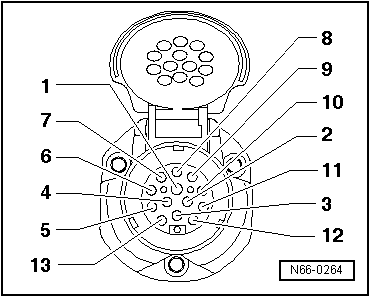
"13-pin" socket for trailer operation
The "13-pin" socket for trailer operation can be used to power the reversing light, "constant current" and the charging line on the trailer. If, for example, a bicycle carrier is fitted or a caravan is towed, it is recommended to always use a "13-pin" socket for trailer operation.
The pin assignment according to DIN ISO 11446 is as follows:
- 1 - Left turn signal
- 2 - Rear fog light
- 3 - Ground for circuits 1 to 8
- 4 - Right turn signal
- 5 - Right side marker light
- 6 - Brake light
- 7 - Left side marker light
- 8 - Reversing light
- 9 - Terminal 30 (constant positive)
- 10 - Terminal 15 (trailer battery charging)
- 11 - Not assigned
- 12 - Not assigned
- 13 - Ground for terminal 15/30
Trailer detection control module -J345-
General description:
The trailer detection control module -J345- detects "trailer operation" from a power consumption of at least 5 W → Note and forwards this information to various control modules via the CAN data bus.
The trailer detection control module -J345- receives information (light control) from the electrical system control module -J519- and central control module for comfort system -J393- via the CAN data bus.
1) At least the turn signal or the position light must be switched on to detect "trailer operation".
Information on testing the control module, fault detection, fault display and fault finding can be found in the Repair Manual → Electrical System.
Retrofitting trailer detection control module -J345-
Retrofitting a trailer detection control module -J345- approved by Volkswagen is basically possible, but causes difficulties due to the connection to the vehicle's CAN data bus. The control module must then be coded using "Guided Fault Finding" → Vehicle Diagnostic Tester.

Note
Installation of control module solutions available on the open market and not approved by Volkswagen is strongly discouraged. Installing such devices voids the warranty! As a rule, these are connected to the tail light and are not sensibly integrated into the vehicle's electrical system. This can lead, among other things, to incorrect diagnosis of the bulb failure monitoring or to malfunctions. Furthermore, dimmed bulbs (combined brake and tail light) cannot be controlled.
Coding trailer detection control module -J345-
The coding is described in → Electrical System.
Engine cooling
Since trailer operation places higher demands on engine cooling, the cooling system is reinforced where technically required when a towing device is fitted at the factory. This is done, for example, by fitting a more powerful or a second radiator fan and/or a larger radiator. Vehicles with tropical specification and/or air conditioning already have reinforced engine cooling. On the Passat, a reinforced radiator fan (PR no. 0Y2) can also be fitted at the factory on its own. This makes later installation of a towing device easier.
Even when a towing device is retrofitted, the cooling system should be reinforced, unless this has already been done at the factory. Otherwise, overheating of the cooling system cannot be ruled out under heavy engine load (mountain driving, high outside temperatures, high towing load). When converting, the engine cooling parts for trailer operation listed in ETKA (Electronic Parts Catalogue) must be used. Also observe the work instructions in the relevant Repair Manuals.
Reinforcement of the cooling system can only be omitted if it is ensured that the engine is only moderately loaded, e.g.:
- permissible combined weight significantly undershot
- no high outside temperatures
- no long, steep gradients
- no driving at high altitude
In any case, the coolant temperature gauge must be closely monitored. If the gauge needle moves far into the hot range, reduce speed immediately. If necessary, a cooling break must be taken. During this, the engine should run at idle speed for approximately 2 minutes to prevent heat build-up.

Note
- On vehicles with air conditioning, the engine cooling can be relieved by switching off the air conditioning. This also improves the starting ability of the combination and makes overtaking maneuvers safer.
- If, by way of exception, reinforcement of the cooling system has been omitted, the seller must inform the buyer of this when the vehicle is sold.
Exterior mirrors
If the traffic situation behind the trailer cannot be seen with the standard exterior mirrors, additional exterior mirrors are required. Both exterior mirrors must be attached to folding arms and adjusted so that an adequate rearward field of vision is guaranteed at all times.
Reinforced dampers and coil springs
- Pitching movements between the towing vehicle and trailer are reduced by reinforced shock absorbers and coil springs on the rear axle. These dampers and springs can, unless already supplied at the factory, often also be retrofitted by Volkswagen dealerships. For the assignment of dampers and springs → Electronic Parts Catalogue "ETKA".
- Pitching and snaking movements are also reduced by stabilizing aids, which can be obtained from Volkswagen dealerships in most European countries and can also be installed there.
Operating and driving notes

Note
Be sure to read and observe the operating and driving notes in the Owner's Manual of your vehicle.
General
Towing device type plate
The towing capacity and nose weight figures on the towing device's type plate are the test values of the device. The approved data for the specific vehicle may be lower than the towing capacity and nose weight figures of the towing device. The vehicle-specific values are
- in this trailer guide,
- in the vehicle documents,
- in the respective owner's manual
listed.
The towing device increases the kerb weight of the towing vehicle, so the payload is reduced accordingly.
Combination weight
The combination weight is made up of the actual weight of the towing vehicle and the actual weight of the trailer. The permissible gross weights of the towing vehicle and the trailer must not be exceeded. If the permissible towing capacity is to be fully used, the weight of the towing vehicle may have to be reduced accordingly.
Tachograph
In many European countries, the installation and use of a tachograph is mandatory for vehicles (including passenger cars) used for commercial goods transport whose permissible gross weight, including trailer or semi-trailer, exceeds 3.5 t. It does not matter whether the towing vehicle and the trailer, or only one of them, is used for commercial goods transport.
Nose weight specifications
The nose weight figures on the towing device's type plate are test values and apply only to the device. The nose weight valid for the vehicle may be lower than these values and must not be exceeded. You can find these specifications:
- in the vehicle registration certificate
- in the vehicle owner's manual
- in this guide
Legal regulations
When towing a trailer, observe the legal regulations of the respective country!
up! 2012 ►
For technical reasons, towing a trailer is not possible with this vehicle.