Brake fluid
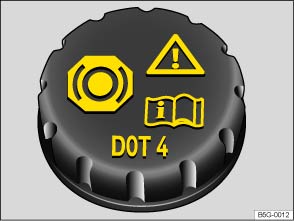 Fig. 101
In the engine compartment: cap of the brake fluid reservoir.
 Read and observe the introductory information
and safety warnings first⇒
 Introduction
to the topic
Brake fluid absorbs moisture from the surrounding air over time. Excessive water content in the brake fluid causes damage to the brake system. Water significantly lowers the boiling point of brake fluid. If the water content is too high, vapor bubbles can form in the brake system under heavy braking and full braking. Vapor bubbles reduce braking effectiveness, significantly lengthen braking distance and can even cause total brake system failure. Your own safety and the safety of other road users depends on a brake system that is always functioning properly ⇒ .
Brake fluid specification
Volkswagen has developed a special brake fluid that is optimized for the vehicle's brake system. For optimal brake system function, Volkswagen expressly recommends using brake fluid that meets VW standard 501 14.
Before using a brake fluid, check whether the brake fluid specification on the container matches the vehicle's requirements.
Brake fluid that meets VW standard 501 14 is available from a Volkswagen Partner.
If such a brake fluid is not available and a different high-quality brake fluid must therefore be used, a brake fluid that meets DIN ISO 4925 CLASS 4 or US standard FMVSS 116 DOT 4 can be used.
Not all brake fluids that meet the requirements of DIN ISO 4925 CLASS 4 or US standard FMVSS 116 DOT 4 have the same chemical composition. Some such brake fluids may contain chemicals that can destroy or damage components of the vehicle's brake system over time.
For a brake system that continues to function properly, Volkswagen therefore recommends using a brake fluid that expressly meets VW standard 501 14.
A brake fluid that meets VW standard 501 14 satisfies the requirements of DIN ISO 4925 CLASS 4 or US standard FMVSS 116 DOT 4.
Brake fluid levelThe brake fluid level must always be between the MIN and MAX marks on the brake fluid reservoir, or above the MIN mark ⇒ .
The brake fluid level cannot be checked precisely on every model, because engine components block the view of the fluid level in the brake fluid reservoir. If the brake fluid level cannot be read accurately, seek expert assistance.
The brake fluid level drops slightly during driving because the brake pads wear and the brakes adjust automatically.
Brake fluid changeHave the brake fluid changed by a specialist workshop. Volkswagen recommends the Volkswagen Partner for this. Only have new brake fluid that has the required specification added.

 Warning
Brake failure or reduced braking effectiveness can be caused by a brake fluid level that is too low, or by brake fluid that is too old or unsuitable.
- Have the brake system and brake fluid level checked regularly!
- Have the brake fluid changed regularly.
- Heavy braking with old brake fluid can cause vapor bubbles to form. Vapor bubbles reduce braking effectiveness, significantly lengthen braking distance and can lead to total brake system failure.
- Make sure the correct brake fluid is used. Only use brake fluid that expressly meets VW standard 501 14.
- Any other brake fluid, or one that is not of high quality, can impair braking function and reduce braking effectiveness.
- If brake fluid to VW standard 501 14 is not available, use a high-quality brake fluid to DIN ISO 4925 CLASS 4 or US standard FMVSS 116 DOT 4 only in exceptional cases.
- The brake fluid added must be new.
Warning Brake fluid is poisonous.
- To reduce the risk of poisoning, never use beverage bottles or other containers to store brake fluid. Such containers can tempt people to drink from them, even if the container is labeled.
- Always store brake fluid in its sealed original container and out of the reach of children.

 Note
Spilled or leaked brake fluid damages the vehicle paint, plastic parts and tires. Wipe spilled or leaked brake fluid off all vehicle parts immediately.

Brake fluid can pollute the environment. Catch leaked operating fluids and dispose of them properly.